What a Fully Automated Business System Actually Looks Like (And How We Build It)
Executive Overview: Automation Is Not the System
Many businesses believe they are “fully automated.”
They have:
CRM workflows
Email and SMS sequences
Scheduling tools
Task automations
Yet growth still feels fragile. More leads mean more stress. More customers mean more manual oversight. Founders remain deeply involved in daily operations.
The reason is simple:
Automation alone does not create a business system.
At MBA (My Business Automated), we build fully automated business systems - end-to-end operating models where marketing, sales, delivery, and retention run as a coordinated, self-reinforcing engine.
This article explains what a fully automated business system actually looks like - and how we design and build it.
Why Most “Automated Businesses” Still Depend on People
Automation is often applied tactically:
A follow-up sequence here
A booking workflow there
A Zap between two tools
These help - but they don’t scale.
Common Signs Automation Isn’t a System
Only one person understands how things work
Manual intervention at every edge case
Inconsistent customer experience
Automation breaks during volume spikes
Growth increases headcount instead of leverage
If your business slows down when one person steps away, you don’t have a system - you have automations.
What Defines a Fully Automated Business System
A fully automated business system is a closed-loop operating model.
It:
Accepts inputs (leads, data, demand)
Applies logic (rules, qualification, routing)
Executes actions (marketing, sales, fulfillment)
Measures outcomes (conversion, revenue, retention)
Self-optimizes based on feedback
Most importantly, it is designed intentionally, not assembled reactively.
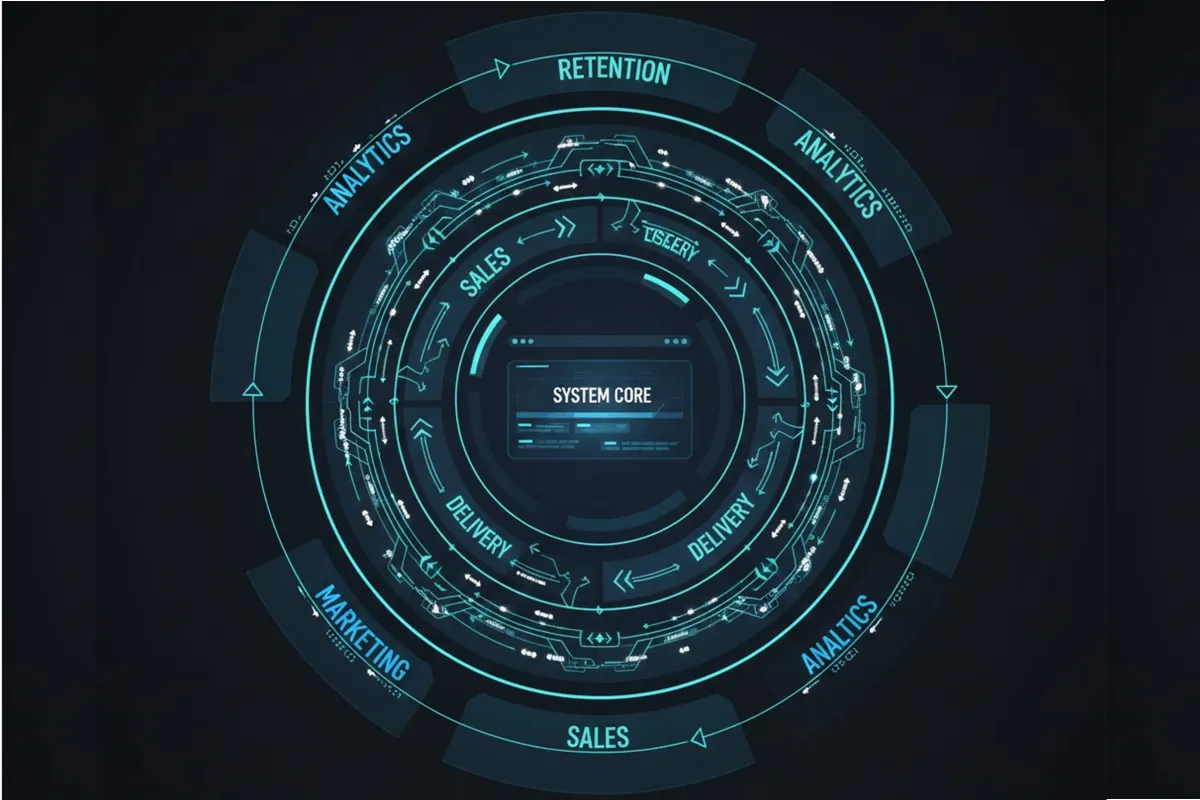
The MBA System Architecture: End-to-End by Design
We design systems across the entire customer and operational lifecycle.
The Core System Layers
Demand Generation & Capture
Lead Qualification & Routing
Sales Enablement & Conversion
Fulfillment & Delivery Operations
Retention, Upsell, and Advocacy
Analytics, Governance, and Optimization
Each layer is automated - but also connected, governed, and observable.
Layer 1: Automated Demand Capture (Without Lead Chaos)
Automation starts at the edge - but with structure.
We design:
Smart forms with conditional logic
Chat and conversational entry points
Source-aware lead tagging
Real-time CRM ingestion
Every lead enters the system cleanly categorized, attributed, and tracked.
No spreadsheets. No inbox chaos. No guessing.
Layer 2: Lead Qualification as a System, Not a Guess
Most businesses automate follow-ups - but not qualification.
We build systems that:
Score leads based on behavior and inputs
Route high-intent prospects instantly
Nurture lower-intent leads automatically
Remove unqualified leads from sales pipelines
This ensures sales teams focus only on ready opportunities.
Automation without qualification just scales noise.
Layer 3: Sales Automation with Human Control
Fully automated does not mean removing humans - it means removing friction.
Sales systems include:
Automated appointment scheduling
Pipeline stage automation
Task creation and reminders
Missed-call text-back systems
Approval and escalation logic
Sales teams operate inside the system, not outside it.
Layer 4: Automated Fulfillment & Delivery
This is where most automation stops - but where systems matter most.
We automate:
Client onboarding sequences
Internal task orchestration
Status updates and notifications
Asset delivery and access provisioning
Delivery becomes predictable, repeatable, and independent of individuals.
Layer 5: Retention, Expansion, and Lifetime Value
A fully automated system doesn’t stop at the sale.
We design:
Post-delivery follow-ups
Review and feedback automation
Upsell and cross-sell triggers
Re-engagement workflows
Long-term nurture sequences
Customers don’t fall through cracks - they move through designed journeys.
Layer 6: Measurement, Governance, and Optimization
Automation without visibility is dangerous.
Every system includes:
Lifecycle dashboards
Funnel conversion metrics
SLA and response-time tracking
Revenue and retention reporting
Exception and failure alerts
What isn’t measured cannot be systemized.
The Artifacts Behind Every Fully Automated Business System
Systems scale because they rely on artifacts, not tribal knowledge.
Core MBA System Artifacts
Business System Architecture Diagram
Customer Lifecycle State Model
Workflow Blueprints (Modular & Reusable)
Automation Governance Rules
Exception Handling Playbooks
Performance & Outcome Dashboards
These artifacts allow:
Faster onboarding
Easier optimization
Lower dependency on founders
Cleaner scaling
Before vs After: Automation vs Systemization
Before
Disconnected tools
Manual fixes everywhere
Founder as bottleneck
Growth increases stress
After
Unified operating system
Automation handles edge cases
Teams operate independently
Growth increases leverage
Typical directional outcomes:
30–60% reduction in manual operations
Faster sales response times
Higher conversion consistency
Lower cost per customer at scale
Why MBA: We Build Systems, Not Just Automations
MBA’s differentiator is systems ownership.
We don’t ask:
“What tool should we use?”
We ask:
“What must this business reliably produce at scale?”
Our approach combines:
Business architecture
Automation engineering
Governance and observability
Long-term scalability thinking
Fully automated businesses aren’t built with tools - they’re built with systems.
Conclusion: Automation Is the Engine - Systems Are the Vehicle
A fully automated business system:
Operates without constant supervision
Delivers consistent outcomes
Adapts as the business grows
Turns effort into leverage
When automation is designed as a system - not a shortcut - growth becomes controlled, predictable, and sustainable.
That’s what a fully automated business actually looks like.
References
Harvard Business Review – Building Scalable Operating Models
https://hbr.org/McKinsey – Business Systems & Operating Models
https://www.mckinsey.com/capabilities/operations/our-insightsGartner – Business Process Automation & Governance
https://www.gartner.com/en/information-technology/insights/business-process-managementMIT Sloan – Digital Business Systems
https://sloanreview.mit.edu/Forrester – Automation Strategy & Scale
https://www.forrester.com/HubSpot – CRM & Lifecycle Automation
https://www.hubspot.com/Salesforce – End-to-End Business Automation
https://www.salesforce.com/products/platform/overview/Bain & Company – Scalable Business Design
https://www.bain.com/insights/topics/operational-excellence/ISO 9001 – Process Standardization
https://www.iso.org/iso-9001-quality-management.htmlDeloitte – Enterprise Automation Strategy
https://www.deloitte.com/global/en/our-thinking/insights.html