The Perfect Follow-Up Timeline: When and How Often Should You Contact Leads?
In this competitive business environment, lead generation is only half the battle today. The true challenge is converting those leads into paying consumers. Too many firms miss prospective sales not because prospects aren’t interested, but because follow-ups are inconsistent, late, or often forgotten entirely.
Studies have repeatedly shown that the bulk of sales happen after many touchpoints. But many companies give up after one or two followup tries. Getting the follow-up schedule right may exponentially increase conversion rates, develop trust and keep your business top of mind.
In this tutorial, we’ll cover the perfect follow-up timeline and how automation can help you make sure no opportunity falls through the cracks.
Why follow-up is more important than ever
The prospect’s attention is at its peak level when they are interested in your product or cracks. at this stage. But that interest can wane rapidly if they don’t hear from you quickly.
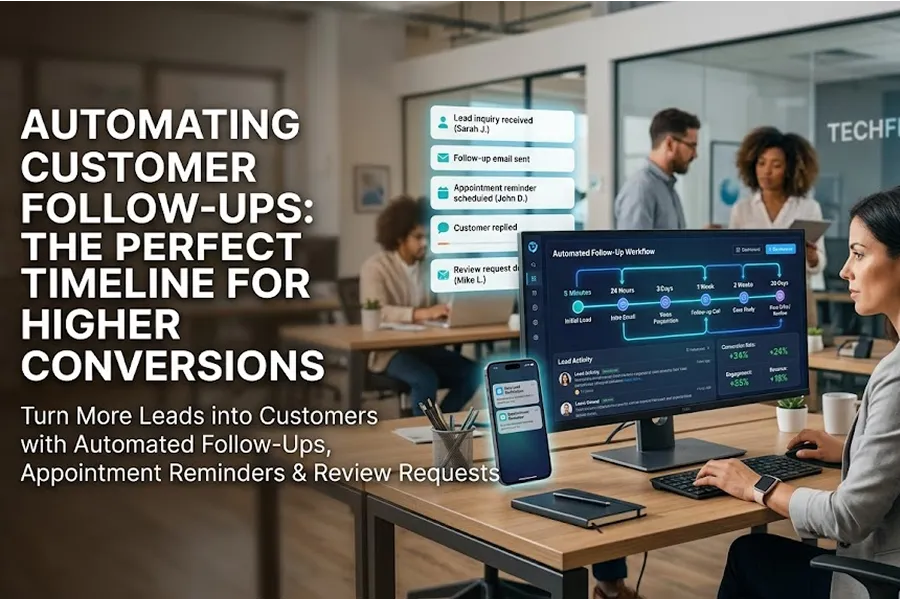
An organized automated customer follow-up system makes sure all the leads are contacted on time without manual intervention from your staff. Engaging and converting customers can be considerably improved by being quick to answer and staying in touch.
The secret is to be persistent and professional. Too many calls can feel invasive to leads, and waiting too long can cause them to forget about your business altogether.
The First Follow-up: Five Minutes
Speed is important.
Research has revealed that contacts made in the initial few minutes are much more likely to convert altogether made hours later. We aim to reply within five minutes of a form submission, question or appointment request.
This first message should:
Thank the prospect for contacting you.
Confirm receipt of their inquiry
Establish expectations for following phases
Here is the information you requested
An automated customer follow up approach guarantees that every lead is promptly attended to, even when it’s outside of typical business hours.
Follow-Up 2: 1 Day Later
If the prospect hasn't replied to your first communication, send a second follow-up in 24 hours.
This conthours. ould be about creating value, not merely inquiring whether they are interested. Please consider sharing:
Useful resources
FAQs
Cases of Study
Success Stories by Customers
It’s to keep the conversation going and to show you know your stuff.
A good automated customer follow up sequence can deliver these messages based on what the lead is interested in and doing.
Follow-Up 3: Three Days Later
Yhours. ospect may still be weighing choices at this point, or they may just be busy.
Send a third touchpoint three days following the second mail that answers typical issues or objections. This is a great place to explain how your solution handles specific difficulties.
If your business is based on consultations, demos or service appointments, this is also an excellent opportunity to add automated appointment reminders to spur scheduling and minimize lost opportunities.
Consistent communication develops trust and keeps your brand top of mind throughout the decision-making process.
Follow-Up 4: One Week Later
One week later your prospect may require a little more push to get involved.
Follow-up should be about social proof and credibility. Think about sharing:
Feedback from Clients
Reviews online
Before and after results
Industry recognition
Businesses that combine automated customer follow up with solid social proof generally find that response rates are higher as prospects feel more confident in their decision to move forward.
Follow-Up 5: Two Weeks Later
Not all leads are ready to buy right away.
Many prospects need more time before making a purchase choice. Checking in at the two-week point maintaiforward. without coming across as pushy.
This message may include:
Educational materials
New deals
Industry knowledge
Answers to FAQ
If you have a meeting or consultation booked, automated appointment reminders are a real time-saver. They assist minimize no-shows and doing. rospects interested during the sales process.
Companies that use automated appointment reminders tend to have better attendance rates and enhanced client experiences.
Follow-Up 6: 30 Days Later
After 30 days, it’s time for a re-engagement email.
The conversation should experiences. and low pressure. Let the prospect know they can contact you when they are ready to move further.
A straightforward message such as:
Just wanted to touch base and see if your priorities have shifted. If you are still looking for solutions, we’re here to help.”
can bring dead talks back to life.
A sophisticated automated customer follow up system may automatically activate these long-term nurture efforts so no lead is ever forgotten.
Why Continuous Nurturing Matters
Many companies just focus on new leads confidence. their existing consumers. But the sale is noforgotten. of the post-sale follow-up.
Staying in touch with consumers opens the door for repeat business, referrals and great reviews.
This is where automated review requests are really useful.
A good experience may lead to a good review, but customers will typically forget to leave one until asked. Automated review requests sent soon after the service is delivered allow you to obtain comments while the experience is fresh.
Besides boosting your online reputation, automated review requests can enhance local search exposure and build consumer confidence.
Follow-Ups today – the automation part
Doing this by hand, for dozens or hundreds of leads, can rapidly get dauntingconfidence. omes to maintaining continuous communication, automation takes away a lot of the pain points.
Companies that are using:
Automated client follow-up
Automatic appointment reminders
Automated review requests
help improve operations while enhancing the client experience.
Automation guarantees every lead is contacted on time, every apconfidence. s confirmed and every happy customer has the chance to give feedback.
Instead than relying on memory or spreadsheets, companies can build workflows that can operate automatically 24/7.
Best Practices for Follow Up
Here are some tips for the best results:
1. Act Fast: The sooner you contact a lead, the greater the chances of converting them.
2. Deliver Value: Each message should provide value, not simply pose a question.
3. Customize Communication: Tailor messaging to client interests, requirements, and past encounters.
4 Consistency: A systematic plan of automated customer follow up makes sure that no opportunities are lost.
5. Cut Down on No-Shows: Automated Appointment Reminders . Increase attendance and satisfaction.
6. Gather Feedback: Build your internet reputation and attract new consumers with automated review requests.
Conclusion
There’s no perfect follow-up schedule to spam prospects with end reques. It’s about sending the appropriate message at the right time.
A structured strategy of quick outreach, follow-up at 24 hours, check-in at three days, weekly engagement, and long-term nurturinsatisfaction. ically increase lead conversion rates.
Companies that use automated customer follow up, automated appointment reminders, and automated review requests will gain a competitien counters. e by having consistent, professional, and scalable communication methods.
In an era where speed and reaction matter more than ever, automation is the key to giving every lead the attention they deserve satisfaction. Are inquiries to customers and more customers to supporters of your business.
References
González-Flores, L. (2025). The relevance of lead prioritization: A B2B lead scoring model based on machine learning. Frontiers in Artificial Intelligence, 8. https://www.frontiersin.org/journals/artificial-intelligence/articles/10.3389/frai.2025.1554325/full
Nanta, T. M., Noermijati, N., Rohman, F., & Hussein, A. S. (2025). The effect of digital touchpoint usage experience on customer loyalty mediated by digital engagement and customer satisfaction. Businesses, 5(1), 3. https://doi.org/10.3390/businesses5010003
Wu, M. (2026). Profiling before scoring: A two-stage predictive model for B2B lead prioritization. Journal of Business & Industrial Marketing. https://www.tandfonline.com/doi/full/10.1080/08853134.2026.2633231
Zimmermann, R., & Auinger, A. (2022). Developing a conversion rate optimization framework for digital retailers—case study. Journal of Marketing Analytics, 11, 233-243. https://doi.org/10.1057/s41270-022-00161-y