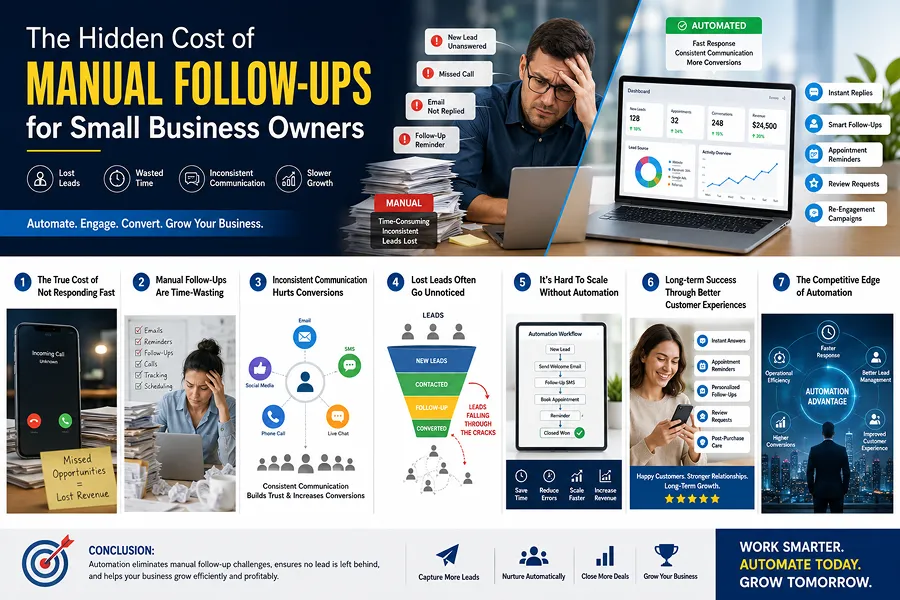
The Hidden Cost of Manual Follow-Ups for Small Business Owners
Many small business owners start their growth with personal interactions. Answering questions, connecting with leads and maintaining client connections are all critical actions that drive revenue and develop trust. As a firm grows, manually following up on these things can become a costly, time-consuming operation.
The truth is, most business owners don’t realize that the real expense of manual follow-ups is not just in the hours spent sending emails or making phone calls. This means wasted chances, lost leads, slower response times, inconsistent customer experiences, and slower business growth. In today’s competitive market manual processes alone can seriously limit a company’s potential.
This is where small business automation is a game-changer for businesses who want to scale efficiently without increasing their workload.
The True Cost of Not Responding Fast
Time and again, research shows leads are most likely to convert when they receive a reply within minutes of an inquiry. But many small businesses answer hours, or even days, later, since they are busy supporting current customers, running operations, or doing administrative work.
It is easy to miss vital messages while following up manually. Those prospects who don’t hear back quickly generally go to competitors who respond more quickly.
A slow response is more than just one lost sale. That means losing the lifetime worth of that customer as well as possible recommendations and future repeat business. Over time, these missed chances accumulate into a huge revenue gap that many business owners never quite see.
An automatic marketing system ensures that all enquiries are answered instantly, even while you’re not at work. This is a professional first impression and holds the interest of the prospects until a team member can speak with them directly.
Manual Follow-Ups Are Time-Wasting
Small business owners wear multiple hats. They are responsible for sales, customer support, operations, accounting and marketing – frequently all in one day.
When you do manual follow-ups, you can spend hours:
Reminder emails
Questions answered
Lead status tracking
Making an appointment
Follow up on quotes
Handling client communications
Each task may just take a few minutes but the cumulative effect might be huge. Many business owners spend time every week doing repetitive communication chores that may just as easily be automated.
This is one of the main reasons why companies are investing in small company automation solutions. Automation takes away the tedious duties so owners and workers may concentrate on higher value activities like closing sales, serving customers and creating growth strategies.
Inconsistent Communication Hurts Conversions
Consistency is a key factor in establishing confidence with your prospects and consumers. However, when follow-ups are done manually, communication is typically unreliable.
Some leads get a quick response while others wait days to hear back. Some clients receive a couple reminders, others receive none. Details may be left out and messages may differ depending on who sends them.
Such inconsistencies may put off your customers and lower your conversion rate.
Automated marketing system ensures that each lead is followed up in a predictable sequence, standardizing communication. Be it a welcome email, appointment reminder, review request, or sales follow-up, automation ensures that each prospect receives the correct message at the right time.
Lost Leads Often Go Unnoticed
Lead leaking is one of the biggest hidden costs of manual follow-up.
Many small businesses get leads using websites, social media, referrals, internet advertising and local networking. But without a dependable method, some of those leads will go through the cracks.
A missed phone call, a forgotten email or a delayed return may not seem like a big deal in the moment, but these small gaps accumulate over time.
Business owners sometimes spend their time trying to get more leads when the true problem is the prospects they have aren’t being nurtured appropriately.
That’s where business growth automation gives a tangible return. Automated workflows track every lead, trigger follow-up activities and ensure no opportunity slips through. Businesses no longer need to rely on recollection or handwritten spreadsheets but have a structured framework to help them manage leads consistently.
It’s Hard To Scale Without Automation
Manual processes work if a business is servicing a few of customers. But with expansion comes complexity.
The more leads you have, the more you need to communicate. More questions = more follow-ups, more appointment confirmations, more reminders and more customer engagement.
Growth without systems can actually cause operational constraints.
Many companies employ people whose sole job is to manage communications. It may require employment, although often automation decreases the requirement for extra administrative workers.
By automating business growth, a company can manage more leads without corresponding increases in human expenditures. Automation workflows don’t take breaks. They run 24/7 so that organizations can scale faster.
Long-term success through improved customer experiences
Customers today demand ease, speed and personalized communication. Meeting these expectations increases the likelihood of earning trust and building long-term partnerships.
This is difficult to achieve with manual follow-ups, particularly when things get busy.
An automated marketing system can improve the consumer experience by:
Answers to questions right away
Automated reminders for appointments
Personalised follow-up sequences
Requests for review
Customer reactivation programs
Communication after purchase
These touchpoints provide a more professional experience and also lessen workload for business owners and workers.
The Competitive Edge of Automation
Many small organizations are still very dependent on manual operations because they believe automation is hard or costly. Automation systems have never been as accessible and economical than they are today.
Using small company automation, companies may outpace the competition, with faster responsiveness, improved lead management and consistent engagement across the whole customer experience.
Automation doesn’t replace human interactions, it enhances them by ensuring no opportunity is missed and no consumer is left feeling forgotten.
The end effect is greater efficiency, improved customer happiness and improved revenue growth.
Conclusion
The hidden cost of manual follow-up is well beyond the time spent writing emails or making phone calls. It affects lead conversion, customer experience, operational efficiency & long term profitability.
Every missed follow-up, late reply or lead that is ignored is revenue lost that you may never get back.
Business growth automation helps small organizations streamline communication, enhance responsiveness and develop scalable systems that lead to sustainable growth. A good automated marketing system helps organizations stay in touch with prospects and consumers and also cuts down on manual work. As competition continues to grow, investing in small business automation is no longer a luxury but a strategic need for organizations looking to develop efficiently and consistently.
Automating the follow-up process allows companies to seize more opportunities, provide better client experiences, and set the stage for future success.
Reference
Here are five high-quality, authoritative external reference links that perfectly align with the specific sections of your blog. They provide credible data, case studies, and industry statistics to back up your claims.
1. For "The True Cost of Not Responding Fast"
Reference Link: Harvard Business Review: The Short Life of Online Sales Leads
Why use it: This is the landmark study validating the "5-minute rule". It proves that businesses responding to leads within an hour are 7x more likely to qualify them than those waiting even 60 minutes. It provides the exact scientific proof for your section on response times.
2. For "Manual Follow-Ups Are Time-Wasting"
Reference Link: Keap: Small Business CRM & Automation
Why use it: Keap (formerly Infusionsoft) is a pioneer in small business automation. Their platform data shows concrete proof of time-saving metrics, with average users saving an estimated 10+ hours per week by automating the very tasks you listed (reminders, appointment scheduling, and invoice follow-ups).
3. For "Inconsistent Communication Hurts Conversions"
Reference Link: HubSpot: 2026 Marketing Statistics, Trends, & Data
Why use it: HubSpot's latest state of marketing data highlights how lead-to-customer conversion rates drop when touchpoints are inconsistent. It provides benchmark data on conversion optimization and standardizing customer journeys to establish trust.
4. For "It’s Hard To Scale Without Automation"
Reference Link: Salesforce: The State of Marketing Report
Why use it: This report details how high-performing businesses scale by utilizing predictive intelligence and marketing automation. It explicitly covers how automated cross-channel marketing creates a seamless customer experience across email, social, and web platforms without forcing companies to exponentially increase human administrative costs.
5. For "Long-term Success Through Improved Customer Experiences"
Reference Link: Campaign Creators: Automated Lead Nurturing Strategies Using HubSpot Lifecycle Automation
Why use it: This guide offers a deep breakdown of lifecycle automation, explaining exactly how automated touchpoints (like post-purchase communication and automated reminders) systematically build pipeline velocity and improve the overall consumer experience.