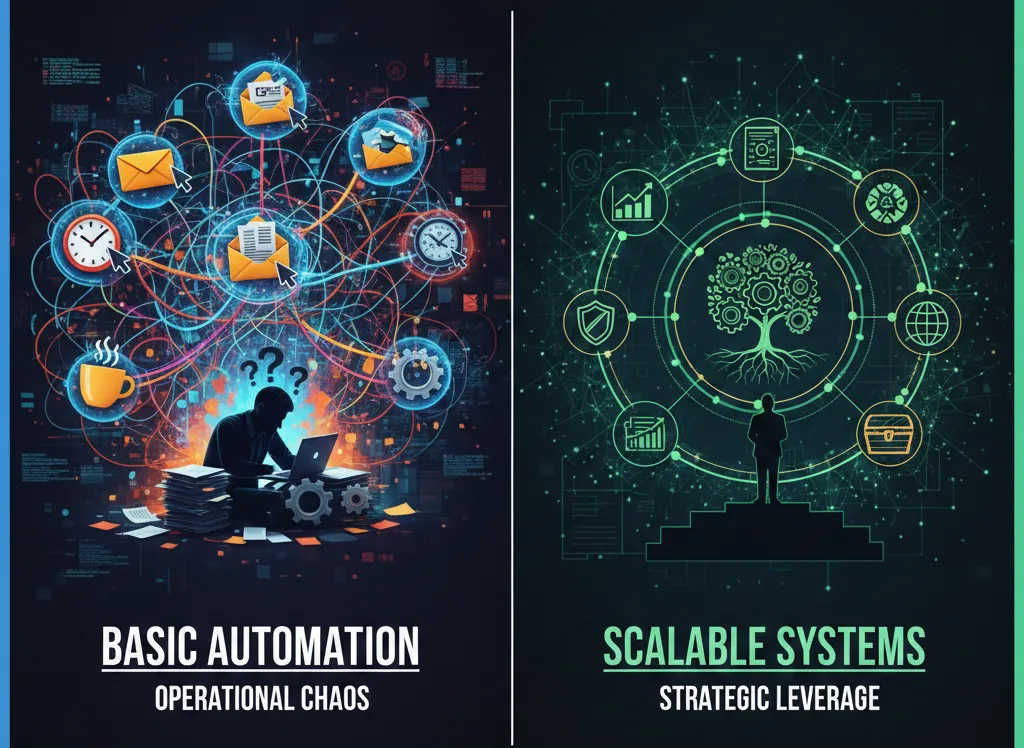
The Difference Between Basic Automation and Scalable Business Systems
Executive Overview: Automation Isn’t the Same as Scale
Most businesses today have some automation.
They use tools to:
Send emails
Capture leads
Schedule appointments
Trigger follow-ups
Yet many of these same businesses still struggle with:
Operational chaos as they grow
Rising costs with no efficiency gains
Systems breaking when volume increases
Founders stuck in day-to-day execution
The reason is simple:
Basic automation saves time. Scalable business systems create leverage.
Understanding the difference is critical for sustainable growth.
The Problem with Basic Automation
Basic automation focuses on isolated tasks, not end-to-end operations.
Typical examples include:
A form triggering an email
A Zapier connection between two tools
A simple CRM follow-up sequence
A chatbot answering FAQs
These automations often work well - until the business grows.
Where Basic Automation Breaks
As volume increases, businesses experience:
Automation conflicts and duplication
No clear ownership or accountability
Manual work creeping back in
Difficulty onboarding new team members
Inconsistent customer experience
Automation without structure accelerates complexity instead of eliminating it.
What Defines a Scalable Business System
A scalable business system is not a collection of automations - it is an operating architecture.
It is designed to:
Support growth without proportional headcount
Maintain consistency across teams and customers
Adapt without constant rebuilding
Operate independently of individual people
Scalable systems are intentional, documented, and governed.
Core Differences: Automation vs Business Systems
1. Task Automation vs Process Ownership
Basic Automation
Automates individual actions
Has no awareness of the full process
Breaks when exceptions occur
Scalable Systems
Own complete workflows end to end
Manage transitions, conditions, and outcomes
Handle exceptions without human intervention
2. Tool-Centric vs Outcome-Centric Design
Basic automation asks:
What tool can do this task faster?
Scalable systems ask:
What outcome must this process reliably deliver?
Systems are designed around:
Revenue generation
Customer experience
Fulfillment accuracy
Retention and lifetime value
Tools are replaceable. Outcomes are not.
3. Short-Term Efficiency vs Long-Term Leverage
Automation improves efficiency today.
Systems create leverage tomorrow.
With scalable systems:
Each new customer adds marginal cost - not linear cost
Each new team member ramps faster
Each new offer plugs into existing infrastructure
This is how businesses grow without breaking.
Why Most Businesses Stall at “Automation”
Many organizations believe they are systemized - but are not.
Common signs:
“Only one person understands the setup”
Automation breaks during promotions or spikes
Manual approvals everywhere
No documentation or governance
Growth creates stress instead of confidence
This happens because automation was added reactively, not architected.
The MBA Approach: Designing Scalable Business Systems
At MBA, we don’t start with tools - we start with business architecture.
Principle 1: Design the System Before the Automation
We define:
Inputs (leads, data, triggers)
States (prospect, customer, inactive, retained)
Transitions (rules, timing, conditions)
Outputs (conversion, delivery, retention)
Automation is layered after the system is clear.
Principle 2: Centralize Logic, Decentralize Execution
Scalable systems:
Centralize rules and logic
Allow execution across channels, teams, and tools
This prevents fragmentation and ensures consistency.
Principle 3: Build for Growth, Not the Current Size
We design systems to handle:
10x lead volume
Team expansion
New offers and markets
Process variation without rebuild
If a system only works at today’s volume, it’s not a system - it’s a shortcut.
Artifacts That Separate Systems from Automation
True systems rely on clear, reusable artifacts.
Core Business System Artifacts
End-to-End Process Maps
Visual flow of how work moves through the businessLifecycle State Models
Clear definitions of customer and lead stagesAutomation Blueprints
Modular, reusable workflowsException Handling Rules
What happens when things don’t go as plannedPerformance Dashboards
Metrics tied to outcomes, not activity
These artifacts ensure the business can scale without tribal knowledge.
Before vs After: Automation vs Scalable Systems
Before (Basic Automation)
Disconnected workflows
Manual fixes everywhere
Founder-dependent operations
Growth increases stress
After (Scalable Systems)
Unified operating model
Automation that adapts
Teams operate independently
Growth increases confidence
Many businesses experience:
30–50% reduction in manual work
Faster onboarding of new hires
Higher consistency in customer experience
Improved margins as volume grows
Why Scalable Systems Create Enterprise Value
Investors, buyers, and partners don’t value automation.
They value predictable, transferable systems.
Scalable business systems:
Reduce key-person risk
Improve operational resilience
Enable faster expansion
Increase business valuation
Systems turn effort into assets.
Conclusion: Automation Is a Tool - Systems Are the Strategy
Basic automation is a good starting point - but it is not the destination.
Businesses that scale sustainably:
Think in systems, not tasks
Design before they automate
Govern before they accelerate
The difference between being busy and being scalable is the difference between automation and systems.
References
Harvard Business Review – Scaling Operations
https://hbr.org/McKinsey – Operating Model Design
https://www.mckinsey.com/capabilities/operations/our-insightsGartner – Business Systems & Process Management
https://www.gartner.com/en/information-technology/insights/business-process-managementMIT Sloan – Digital Business Models
https://sloanreview.mit.edu/Forrester – Business Automation Strategy
https://www.forrester.com/Salesforce – Business Process Automation
https://www.salesforce.com/resources/articles/business-process-automation/HubSpot – Scaling Operations with Automation
https://www.hubspot.com/Bain & Company – Operational Excellence
https://www.bain.com/insights/topics/operational-excellence/ISO 9001 – Process Standardization
https://www.iso.org/iso-9001-quality-management.htmlDeloitte – Enterprise Operating Models
https://www.deloitte.com/global/en/our-thinking/insights.html