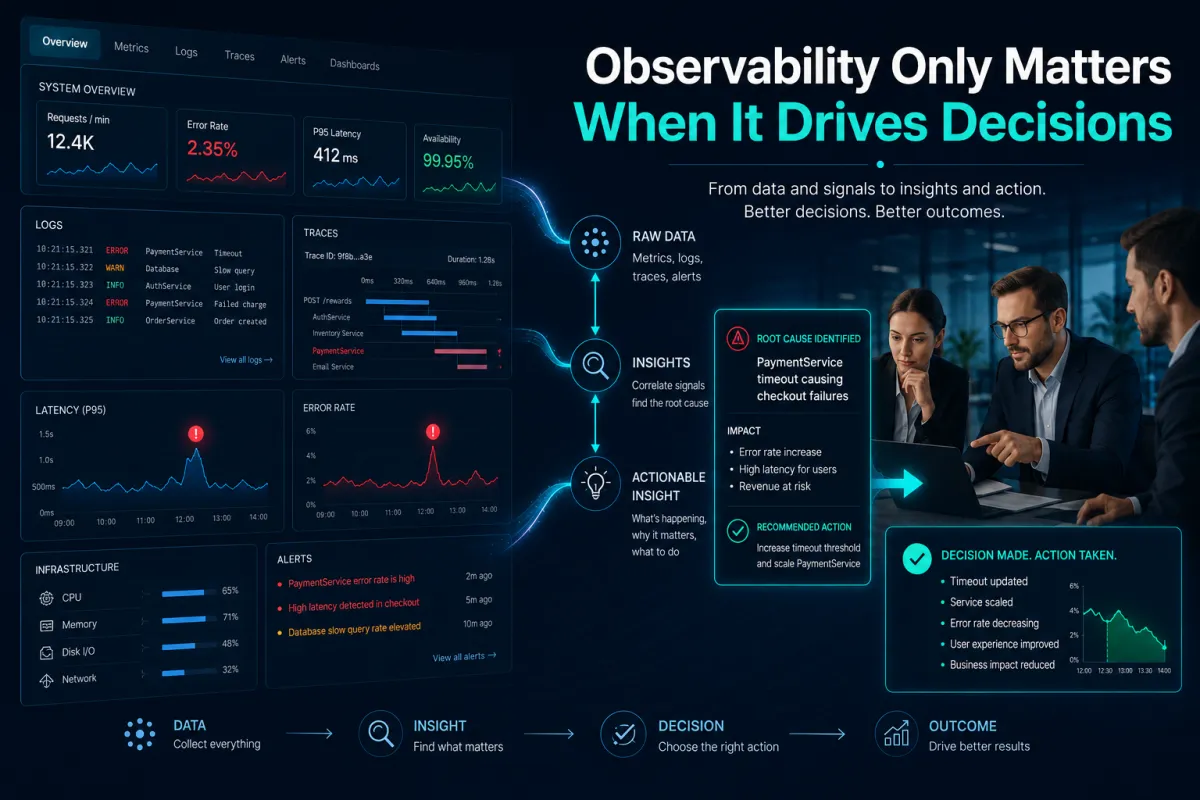
Observability Only Matters When It Drives Decisions
Executive Snapshot: Observability Only Matters When It Drives Decisions
Most enterprises today are rich in dashboards—but poor in clarity.
Metrics, logs, traces, and alerts flood teams with data, yet executives still struggle to answer basic questions:
Are we at risk right now?
Where is performance impacting revenue or customer trust?
Which issues require leadership attention—and which do not?
Observability becomes valuable only when it moves leaders from visibility to action.
This is the shift from dashboards to decisions—and it’s where observability delivers real business value.
The Leadership Problem with Traditional Observability
Observability initiatives often start with the right intent but stall due to common pitfalls:
Tool-centric implementations without business alignment
Too many metrics, not enough meaning
Engineering dashboards that don’t translate to executive insight
Alert volume without prioritization or context
No clear ownership for turning signals into action
Visibility without decision context creates noise, not confidence.
For leaders, observability must answerwhy something matters, not justwhat is happening.
Why Observability Is a Business Capability, Not a Technical Feature
At the leadership level, observability directly impacts:
Revenue protection (outages, slowdowns, failed releases)
Customer experience and retention
Operational risk and compliance posture
Cost efficiency and productivity
When framed correctly, observability becomes adecision support systemfor the business—not an engineering telemetry layer.
What “Actionable Observability” Means for Leaders
Actionable observability connects technical signals to business outcomes.
It enables leaders to:
See risk before customers feel it
Understand tradeoffs between speed, cost, and stability
Prioritize issues based on business impact, not alert count
Hold teams accountable using shared metrics
This requires moving beyond raw dashboards to curated, outcome-driven insight.
The Shift from Metrics to Meaning
1. From Alert Volume to Signal Quality
Leaders don’t need more alerts—they need fewer, better signals.
Actionable observability focuses on:
Reducing alert noise
Highlighting anomalies that affect customers or revenue
Surfacing trends, not just incidents
Organizations that mature observability typically reduce alert volume by50–80%, while improving response speed.
2. From System Health to Business Impact
Technical metrics become actionable only when mapped to outcomes such as:
Transaction success rates
Customer experience indicators
Revenue-impacting services
SLA and SLO adherence
Leaders don’t manage latency—they manage the cost of latency.
3. From Reactive to Proactive Decision-Making
When observability is structured correctly, it enables:
Early detection of degradation
Forecasting of capacity and risk
Informed go/no-go deployment decisions
This shifts leadership posture from firefighting to foresight.
Artifacts That Turn Observability into Executive Action
High-performing organizations rely on executive-ready artifacts, not raw dashboards.
Key Observability Artifacts for Leaders
Executive Health Scorecards
Aggregated view of system health tied to business servicesBefore vs After Performance Snapshots
Demonstrates impact of observability investmentsMTTR & Incident Cost Summaries
Translates recovery time into financial and customer impactRisk & Stability Heatmaps
Highlights where leadership attention is neededDeployment Readiness Dashboards
Supports release decisions with confidence
These artifacts create a shared language between engineering and leadership.
Before vs After: Observability That Drives Decisions
Before Actionable Observability
Dozens of dashboards, little clarity
Leaders rely on anecdotes and escalations
High alert noise and slow response
Reactive incident management
After Actionable Observability
Clear executive-level insight
Faster, data-backed decisions
Reduced MTTR (often40–60%)
Improved trust between leadership and delivery teams
The Leader’s Role in Making Observability Actionable
Observability does not become actionable by accident.
Leadership must:
Define what “business impact” means
Demand outcome-aligned metrics
Limit dashboards to decision-relevant views
Assign ownership for interpretation and response
Observability without ownership creates awareness—but not accountability.
Why Observability Fails Without a Decision Framework
Many organizations invest heavily in observability tools yet see limited value because they lack:
A decision hierarchy
Clear escalation paths
Defined thresholds tied to business impact
Governance around what leaders should see—and when
Tools generate data.Frameworks generate decisions.
Conclusion: From Seeing to Leading
Observability reaches its full potential when it stops being a technical reporting layer and becomes a leadership enablement system.
Enterprises that succeed make a clear shift:
From dashboards → decisions
From data → direction
From noise → confidence
When observability is actionable, leaders don’t just see the system—they steer it.
References
Google DORA – Accelerate & State of DevOps
https://cloud.google.com/devops/state-of-devopsGartner – Observability and Business Value
https://www.gartner.com/en/information-technology/insights/observabilityMcKinsey – Technology and Operational Performance
https://www.mckinsey.com/capabilities/mckinsey-digital/our-insightsCNCF – Observability and Cloud Native Operations
https://www.cncf.io/reports/AWS – Observability Best Practices
https://aws.amazon.com/observability/IBM – Observability and Business Outcomes
https://www.ibm.com/topics/observabilityHarvard Business Review – Data-Driven Leadership
https://hbr.org/NIST – Risk Management Framework
https://www.nist.gov/rmfSRE Workbook – Actionable Metrics
https://sre.google/workbook/Splunk – Observability Maturity
https://www.splunk.com/en_us/observability.html