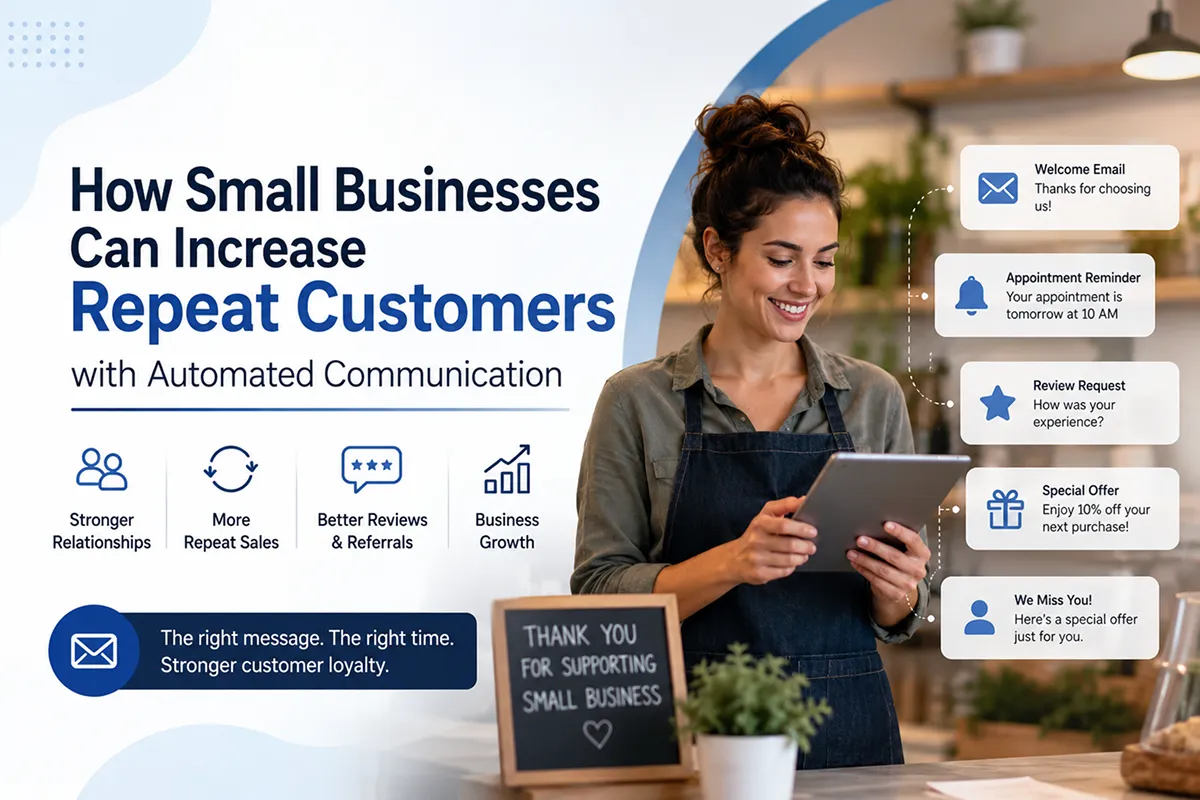
How Small Businesses Can Increase Repeat Customers with Automated Communication
Today, running a small business is not just about getting new customers but providing them a reason to come back. Most business owners spend a ton of money on advertising and lead creation, yet they often miss one of the most profitable development strategies: keeping existing clients.
Consider. Each repeat customer already trusted your business. They know your items, they know your service, and they need significantly less convincing than a person discovering your company for the first time. But many small businesses lose these precious consumers just because they cease to talk to them after the first sale.
The good news is you don’t have to spend hours on physical work to stay in touch with customers. Automated communication allows businesses to forge better relationships, boost customer satisfaction, and stimulate repeat purchases without taxing an already packed schedule.
Repeat Customers Matter More Than Ever
The cost of getting new clients is growing. Sometimes, you need to make a large investment in internet advertising, social media campaigns, and marketing costs to get a first-time buyer. Industry research regularly reveals that retaining existing customers is significantly more cost-effective than gaining new ones, making customer retention one of the highest-return investments a corporation can make.
Returning consumers tend to also:
Spend more over a longer period of time.
Purchase more often.
Tell your friends and family.
Write positive reviews.
Turn your customers into champions for your business.
In short, loyal consumers produce more revenue and also assist in bringing in new customers through word-of-mouth referrals.
The Small Business Money-Losing Communication Gap
Many companies lose consumers without ever realizing it, because the communication ends once the sale is made.
Think about yourself walking into a local hairdresser, shopping at an online store, or engaging a service provider. You get good service, you pay up, and then quiet.
Weeks go by, months go by, and there is no further word from the firm.
Or you need that service again, and another firm shows up on your social stream, and you go with them because they were there.
It happens every day.
Poor quality alone is rarely enough to make customers forget about firms. The business leaves their lives, and so they forget, most of the time.
Regular communication keeps your business front of mind.
What does automated communication mean?
Automated communication is about ensuring the correct consumer gets the right message at the right time, without having to manually send each email or text message.
Automation takes the work out of remembering to follow up with each customer individually.
Some examples are:
Welcome messages following a new purchase
Appointment reminders
Thank you emails
Birthday wishes
Request reviews
Special Discounts
Product recommendations
Campaigns to re-engage dormant customers
Once established, these workflows continue to run 24/7, so every single customer receives relevant and timely contact. Automation feels personal when done right
One of the biggest misconceptions regarding automation is that it’s robotic.
The truth is just the contrary.
Modern automation platforms customize messaging to customer information such as:
Name
Past purchases
History of appointments
Location
Hobbies
Frequency of purchase
Customers are receiving relevant messaging regarding their experience, rather than canned advertising emails.
For instance:
"Hi Sarah, hope you’re enjoying your new skincare items. It’s been around 30 days and you might be ready for a refill. Here is 10% off your next purchase."
That sounds more considered than automated.
5 Automated Messages Every Small Business Owner Needs to Be Using
1. Welcome Your New Customers
First impressions count.
Once someone makes their first purchase, send them a friendly welcome message thanking them for choosing your business.
Include:
A word of thanks
Useful information
Contact information
Social media links
Expectations of future communication
This develops trust immediately.
2. Follow Up After Every Purchase
Most companies don’t have this opportunity.
A quick follow-up message asking, ""What was it like?"
shows customers that you really care.
It also provides unsatisfied consumers an opportunity to speak with you before publishing nasty reviews online.
3. Automatically Ask for Reviews
Happy customers will typically give reviews, but only if you ask for them.
Automate the procedure and not have to remember to ask for feedback manually.
Review requests are common between 24 and 48 hours after a completed transaction, which generates far more input than other times.
Positive reviews assist in developing trust and attracting prospective clients.
4. Celebrate customer anniversaries
Birthdays, anniversaries, and loyalty milestones provide great opportunity for re-engagement.
A tiny discount and a simple birthday note can spur another purchase and make consumers feel appreciated.
Little things make a lasting impression.
5. Re-Engagement of dormant customers
Not every consumer comes back on their own.
Automation can send a pleasant reminder if someone hasn’t bought anything in three months or six months.
Better than to say:
"We haven’t seen you.”
Give this a shot:
"We've missed you! Here’s a special welcome-back offer for you.
This is a very appealing approach, not a sales-focused approach.
Choosing the Right Channels to Communicate Through
Different clients like different ways of communicating.
Successful businesses tend to approach this in a multi-channel way:
Email for emails, educational content, deals, and updates.
SMS for appointment reminders, confirmations, and limited-time discounts.
Use WhatsApp for customer support, order updates, and individualized discussions as necessary.
CRM notifications so your team is guaranteed to follow up with high-value customers.
Utilizing various channels in concert provides a seamless customer experience and helps companies stay linked along the customer journey. Coordinated email and messaging campaigns have been shown to have better client retention than using only one channel of communication.
Be useful, not salesy in your messages
Automation should develop relationships, not drown clients in stuff.
Don’t promote all the time.
Instead, mix your messaging with valuable content.
Examples are
Handy hints
Service reminders
How to use the product
Recommendations for the season
Customer success stories
Educational material
When customers receive value with each and every message, they are far more inclined to open the next one.
How Much Matters
Automation also provides you with vital insights into how customers behave.
Track metrics like:
Email Open Rate
Click-through rates
Confirmations of appointments
Repeat customer purchasing rate
Lifetime worth of customers
Evaluate submissions
Customer engagement
These numbers let you see which messages are working and where you can improve.
Little improvements over time might add up to big wins in client retention. Automation Can’t Substitute Human Relationships
Some business owners say automation might make communication less human.
In fact, automation takes care of monotonous activities so you can spend more time on important conversations when they matter most.
Your staff may spend less time manually sending reminders or thank-you emails and more time fixing customer problems, answering inquiries, and delivering memorable experiences.
Automation is an enabler of relationships, not a substitute for them.
Conclusion
Every consumer you have is a chance to expand.
Unfortunately, many businesses spend thousands to recruit new consumers while ignoring the very people who have already chosen them.
That changes with automated communications.
By providing timely, relevant, and tailored communications, small businesses can stay connected, create better relationships, boost customer loyalty, and generate more repeat business all without adding extra labor to their everyday operations.
The companies that succeed in years to come will not necessarily be the ones with the highest advertising budgets. And it will be these people who will continue to foster consumer connections long after the first purchase.
If you want to develop your business in a sustainable way, improve the discussions you have after the sale. Proper automation turns every touchpoint into an opportunity to turn new clients into repeat buys who become long-term customers.
References
Gallo, A. (2014). The value of keeping the right customers. Harvard Business Review, 13(1), 1–8. https://hbr.org/2014/10/the-value-of-keeping-the-right-customers
Shanmugam, S. (2026). A segmented machine learning approach to predicting and mitigating churn in the gig economy. Journal of Theoretical and Applied Electronic Commerce Research, 21(3), 93–110. https://doi.org/10.3390/jtaer21030093
Song, H. G., & Jo, H. (2023). Understanding the continuance intention of omnichannel: Combining TAM and TPB. Sustainability, 15(4), 3039. https://doi.org/10.3390/su15043039
Sunardi, Mulyo, J. H., Irham, & Jamhari. (2023). Assessing brand switching level and behaviour of growing-up milk products in Java: A structural equation modeling and multigroup analysis. Heliyon, 9(5), e15969. https://doi.org/10.1016/j.heliyon.2023.e15969
Yeğin, T., & Ikram, M. (2022). Developing a sustainable omnichannel strategic framework toward circular revolution: An integrated approach. Sustainability, 14(18), 11578. https://doi.org/10.3390/su141811578