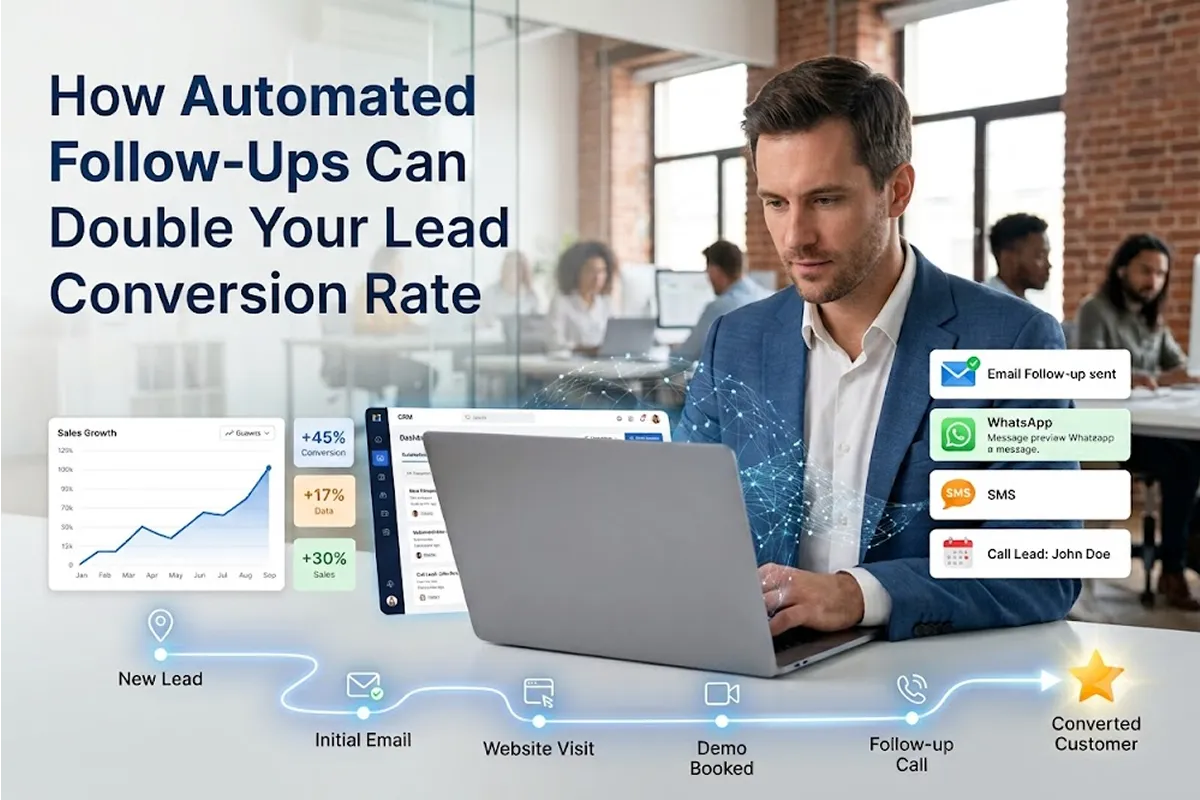
How Automated Follow-Ups Can Double Your Lead Conversion Rate
Getting leads is half the fight. The true problem starts when someone completes your contact form, downloads your guide, or seeks a price. Unfortunately, many companies miss out on important chances simply because they don’t follow up promptly or consistently.
In today’s competitive environment, prospects are expecting a rapid reply. If your business takes hours or even days to respond, chances are your competitors have already reached out.
This is where automatic follow-ups can be a game-changer.
Companies who use automated follow-up solutions not only get back to people faster, but they also nurture leads consistently through various touch points. The consequence? This leads to more appointments, higher engagement, and a considerable increase in conversion rates.
In this post, we’ll discuss why automated follow-ups work, the evidence behind their success, and how organizations can use automation to massively enhance their lead conversion rates.
Why Most Leads Never Close
Many businesses spend a lot of money on advertising, SEO, social media, and paid campaigns to get some leads. But industry statistics show that many businesses constantly fail to follow up on leads in a timely manner.
The problem is not usually lead quality; it is process.
Typical problems are the following:
slow responses to questions
missed emails/phone calls
Manual follow-up that requires busy sales people
Bad communication
No time-based lead nurturing
The longer you wait, the less likely a prospect will become a customer.
HubSpot suggests that decreasing lead response time increases the likelihood of connecting with and converting prospects since firms reach out to buyers at their peak interest.
Speed Is More Important Than You Think
Imagine asking three companies for a quote.
The first company calls back in two minutes.
The second is an email four hours later.
The third replied the following day.
Who do you think you can believe?
Studies have shown that businesses that are the first to respond have a huge competitive edge.
Common sales data include the following:
Companies that respond to leads within 5 minutes are 9x more likely to convert them than companies who respond later
Research shows 35%-50% of sales go to the first company that responds.
Responding to your calls within the first minute can increase lead conversion rates by up to 391% compared to waiting.
These data indicate one fundamental fact: Speed is opportunity.
If you’re a developing firm, it’s practically impossible to keep up with immediate replies manually.
Automated Follow-Ups: What Is It?
Automated follow-ups are pre-designed communications that are triggered to be sent out when a lead makes a certain step.
Examples include:
Submissions via contact forms
Appointment request
Phone calls missed
Chat questions on website
Facebook Lead Ads
Google Ads conversions
Downloading eBook
Schedule a consultation
Rather than relying on your staff to remember to answer, automation kicks in and automatically sends out emails, SMS messages, or WhatsApp messages or even assigns tasks to your sales team right away.
This means every lead gets immediate attention, 24 hours a day, 7 days a week.
How Multiple Follow-Ups Can Increase Your Conversions
One of the biggest illusions in sales is that prospects buy on first interaction.
In reality, however, buying decisions are usually multi-touchpoint.
Sales research indicates:
80% of sales occur on the fifth follow-up or later.
44% of salespeople quit after just one follow-up.
Almost 50% of sales reps don’t follow up beyond the first contact.
This gap presents a significant opportunity for companies utilizing automation.
Automated workflows, however, keep leads warm with a series of useful messages rather than depending on recollection or regular reminders.
For instance,
Day Zero
Thank you email, immediate
Confirmation by SMS
Sales alert
Day 2
Materiales educativos
Questions fréquentes
Day 5
Customer success story
Case study
Day Eight
Limited-time special
Free consultation warning
Day 12
Personal contact by sales representative;
Every touchpoint keeps your business front of mind until the prospect is ready to buy.
How Automation Enhances Customer Experience
Automation isn’t the end of human engagement.
And it's about improving it.
Automation enables instant acknowledgment rather than making prospects wait hours for responses while delivering qualifying leads to the right salesperson.
Customers love:
Instant acknowledgment that their question has been received
Easier appointment scheduling
Helpful facts to know before you talk to sales
Regular communication
Customized messages based on what they care about
Instead of feeling neglected, prospects go through a seamless, professional purchase process.
Automated Follow-Ups: The Business Benefits
Businesses that automate follow-ups generally see benefits in a number of key performance indicators.
Improved Lead Conversion Rates: Fast answers keep leads engaged before your competitors may contact them.
Sales Team Productivity Boost: Sales reps spend less time sending redundant emails and more time closing quality leads.
Less Missed Opportunities: Capture attention instantly on every lead, even outside of work hours.
Improved Lead Qualification: Automation gathers more information via forms, surveys, and discussions so sales staff can focus on high-value prospects.
Talk to your customers regularly: All prospects get the same amount of professional experience, no matter who originated the lead.
Automation in Action
For example, a local home services company that gets 40 service requests a week.
Earlier:
Leads were received by email.
Staff responded when they had time.
In the morning there were many questions to be answered.
Some leads were completely lost.
Following automation:
Every query receives an email within seconds.
The SMS confirms the request immediately.
Automatic booking of appointments.
Notifies salespeople in real time.
No-shows are reduced by reminder texts.
Ongoing follow-up campaigns are in place for leads not yet booked.
The organization only boosts its conversion rate by responding quicker and remaining engaged during the buying journey without spending more on advertising.
Tools that make automation a breeze
Modern CRM and marketing automation tools make sophisticated follow-up sequences shockingly easy.
Some of the popular features are:
Email automation programs
SMS-marketing
Automation for WhatsApp
Pipeline management
schedule appointments
Chatbots powered by AI
Scoring Leads
Automate Workflow
Text-back for missed calls
Campaigns for reviews ask
Platforms like GoHighLevel bring these functionalities together in one place, allowing businesses to handle marketing, sales, and customer interaction without needing to use different apps.
How to Create a Follow-Up Campaign that Converts
Automation is best when it’s clever, not overwhelming.
Remember these great practices:
Respond promptly after a lead files a query.
Customize the messages based on the prospect’s name and interests.
Provide useful information, not endless sales pitches.
Combine communication methods such as email, SMS, and phone calls.
Make sure each message contains a clear call to action.
Keep nurturing leads over weeks, not just a single week.
Always measure open rates, click rates and conversion metrics to optimize campaigns
Automation should be about bettering connections, not making communication robotic.
Conclusion
Many companies think they need more leads to improve their income.
In fact, many just need to improve their conversion rate of leads they already have.
Automated follow-ups ensure that every inquiry gets a quick response, every prospect is nurtured regularly, and every opportunity gets the best possible chance of turning into a customer.
Data is data. Speed of response, consistency of follow-up, and engagement all the way through the purchase journey have a measurable impact on conversion rates. Automation isn’t only about saving time. It’s about building a more scalable and reliable sales process.
If your organization is still using human follow-ups, now is the moment to automate. With the proper solution, you can reply faster, better engage prospects, and turn more leads into loyal customers, all without increasing your marketing budget.
Reference
Harvard Business Review / Chili Piper — Speed to Lead Data: Check out the data behind why the "5-minute rule" is so crucial. Studies show that responding to a web lead within one minute increases your conversion rate by a massive 391%. You can explore these timing benchmarks in detail via Chili Piper's Speed to Lead Analysis.
Amplemarket — HubSpot Response Statistics: To back up your point about HubSpot's stance on immediate response times, this industry study reveals that while the average B2B response time drags out to 42 hours, reaching out within 5 minutes makes you 21 times more likely to qualify that prospect. Read the full metric breakdown at Amplemarket's Lead Response Time Deep Dive.
LeadResponse / SPOTIO — The 5+ Touchpoint Rule: Your blog mentions that 80% of sales require at least 5 follow-ups, yet nearly half of all reps give up after just one attempt. This comprehensive sales analysis documents exactly why multi-touch sequences are non-negotiable for growing revenue: LeadResponse Sales Follow-Up Statistics.
GoHighLevel — Automation Platform & Workflows: For the section discussing modern CRM tools and automated multi-channel sequences (SMS, email, and WhatsApp), you can reference GoHighLevel’s native capabilities. Take a look at their official product capabilities on GoHighLevel's Automated Follow-Ups feature page.