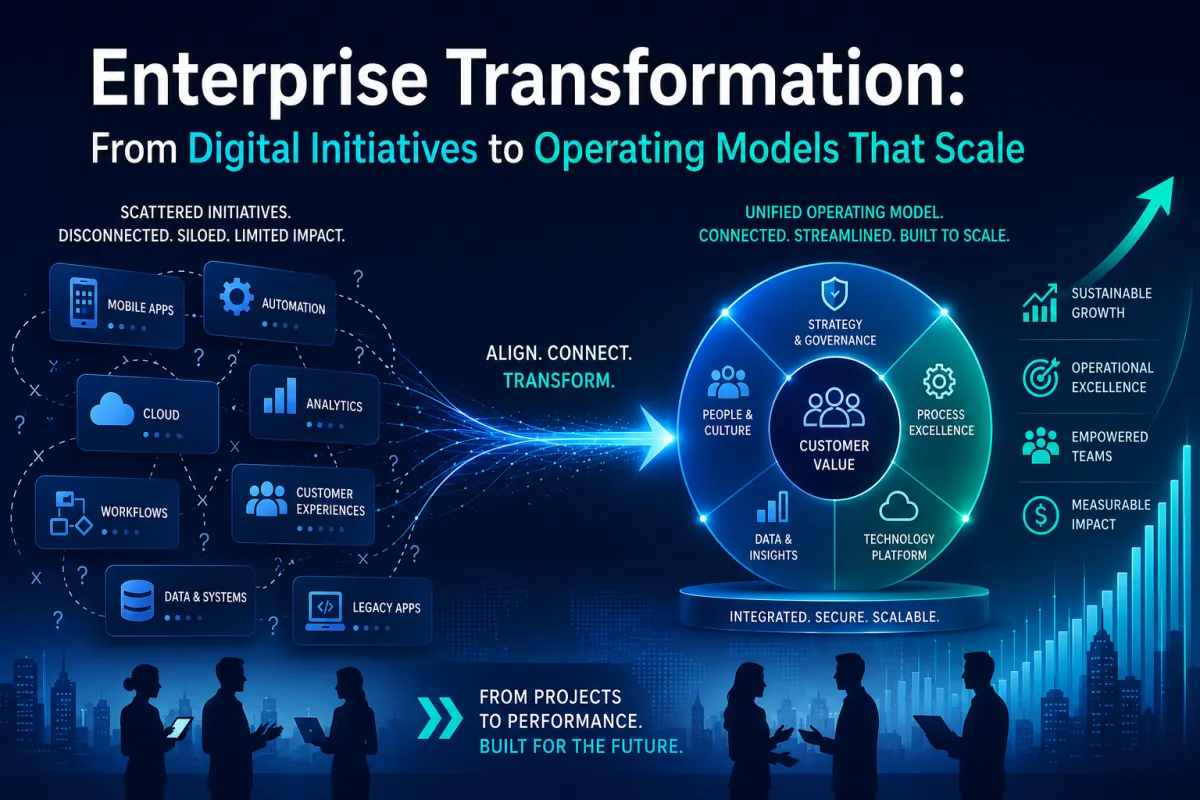
Enterprises invest heavily in digital platforms
when operating models change
Enterprise transformation rarely fails because organizations lack ambition.
It fails because transformation is treated as a project, not an operating model.
Enterprises invest heavily in digital platforms, agile programs, AI pilots, and cloud migrations—yet still experience:
Disconnected transformation initiatives
Speed without stability
Innovation without scalability
Technology change without business impact
True enterprise transformation begins only when operating models change.
Why Enterprise Transformations Stall at Scale
Most enterprises follow a predictable transformation path:
Vision statements are compelling
Digital roadmaps are ambitious
Pilot programs show early promise
Enterprise-wide execution fragments
This breakdown occurs because transformation is often positioned as:
A technology program, not a business system
A temporary change effort, not a permanent operating discipline
A set of initiatives, not an integrated model
Transformation without an operating model creates momentum without durability.
The Operating Model Lens: Before vs After Transformation
Enterprise transformation succeeds when organizations redesign how work gets done, not just what tools are used.
Before Transformation
Functional silos dominate execution
Decisions escalate through layers
Technology teams operate separately from business
Metrics focus on output, not outcomes
Change is episodic and disruptive
After Transformation
Cross-functional, value-aligned teams
Decentralized, outcome-driven decisions
Business and technology co-own delivery
Metrics track customer and business impact
Change becomes continuous and controlled
Transformation shifts from reactive execution to intentional design.
What Makes Operating-Model–Led Transformation Different
Operating-model–led transformation is not a methodology—it is an enterprise design discipline.
It is grounded in three principles:
Structure enables strategy
Governance enables speed
Capabilities outlive tools
This approach ensures transformation scales predictably, not heroically.
Pillar 1: Value-Stream-Aligned Execution
Traditional enterprises organize around functions.
Transformed enterprises organize around value creation.
Instead of optimizing departments, leaders optimize:
Customer journeys
Revenue flows
Risk and compliance pathways
Data and decision pipelines
Execution becomes aligned to outcomes—not org charts.
Pillar 2: Platform Thinking Over Point Solutions
Most transformations fail due to tool sprawl.
Operating-model–driven enterprises design platform capabilities such as:
Shared data foundations
Reusable integration layers
Standardized security controls
Common delivery frameworks
Tools support platforms.
Platforms support scale.
Pillar 3: Embedded Governance as a Design Feature
Governance is often introduced after transformation begins—creating friction.
In mature operating models, governance is:
Embedded into workflows
Codified through automation
Clear in decision rights
Outcome-focused rather than approval-driven
The result is speed with control, not speed versus control.
Core Artifacts of a Scalable Transformation Operating Model
Like the MBA Approach, successful transformations rely on durable artifacts, not slideware.
Foundational Transformation Artifacts
Enterprise Operating Model Blueprint
Defines how strategy, delivery, governance, and technology interactValue Stream Architecture
Maps how value flows across teams, platforms, and partnersCapability Heatmap
Identifies strengths, gaps, and investment prioritiesDecision Rights Framework
Clarifies who decides, at what level, and based on which signalsTransformation Scorecard
Tracks progress using business-aligned outcomes
These artifacts ensure transformation survives leadership changes, tool evolution, and organizational growth.
Before vs After: Transformation Without vs With an Operating Model
Before
Parallel initiatives with limited coordination
Fast pilots that stall at scale
Escalation-heavy decision making
Transformation fatigue
After
Integrated enterprise roadmap
Predictable scaling of innovation
Clear accountability and ownership
Sustained momentum
Transformation becomes repeatable, not fragile.
Why Operating-Model–Led Transformation Scales
Enterprise complexity increases with:
Global expansion
Regulatory pressure
Technology diversity
Ecosystem partnerships
Operating models scale because they:
Are system-driven, not personality-driven
Balance autonomy with alignment
Reduce dependency on individual leaders
Treat transformation as an ongoing discipline
Enterprises don’t fail to transform because they lack tools.
They fail because they lack coherence.
Leadership’s Role in Enterprise Transformation
Transformation cannot be delegated.
Effective leaders:
Anchor transformation to business outcomes
Reinforce operating discipline
Demand transparency and measurement
Treat technology as enterprise infrastructure, not experimentation
Leadership behavior—not technology—sets the ceiling for transformation success.
Conclusion: Transformation as an Operating System
Enterprise transformation succeeds when it evolves from initiative execution to operating model design.
It replaces:
Fragmentation with coherence
Speed without control with disciplined agility
Change programs with continuous evolution
When transformation becomes an operating system, enterprises gain resilience, scalability, and sustained competitive advantage.
References
Harvard Business Review – Organizational Transformation
https://hbr.org/McKinsey – Operating Model Transformation
https://www.mckinsey.com/capabilities/people-and-organizational-performanceGartner – Enterprise Operating Models
https://www.gartner.com/en/information-technologyMIT Sloan Management Review – Digital Transformation
https://sloanreview.mit.edu/Bain & Company – Business Model & Operating Model Design
https://www.bain.com/insights/topics/digital-transformation/Deloitte – Enterprise Transformation Strategy
https://www.deloitte.com/global/en/our-thinkingAccenture – Operating Model Reinvention
https://www.accenture.com/us-en/insights/strategyWorld Economic Forum – Enterprise Transformation
https://www.weforum.org/agenda/ISO – Governance of Organizations
https://www.iso.org/committee/383747.htmlIBM Institute for Business Value – Transformation at Scale
https://www.ibm.com/thought-leadership/institute-business-value