What DevOps Automation Delivers to the CFO (Not Just Engineers)
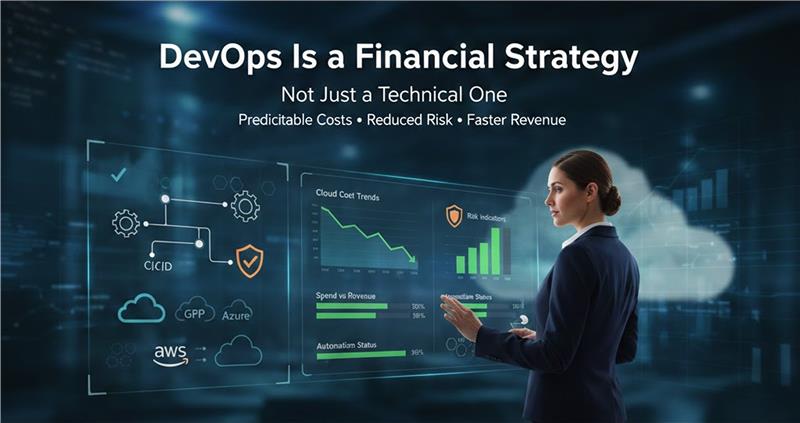
DevOps Is a Financial Strategy, Not Just a Technical One
DevOps automation is often framed as an engineering accelerator - faster releases, better uptime, happier developers. But for CFOs, its real value lies elsewhere.
DevOps automation is fundamentally a financial control mechanism.
When implemented correctly, it delivers:
Predictable operating costs
Reduced financial risk from outages and errors
Faster revenue realization
Measurable efficiency gains across IT operations
In an era of cloud spend scrutiny and margin pressure, DevOps automation has become aboard-level lever for cost optimization and operational predictability.
The CFO’s Core Challenge with Modern IT
From a finance perspective, modern IT environments present persistent challenges:
Cloud costs grow faster than revenue
Forecasting infrastructure spend is unreliable
Outages translate directly into lost revenue and brand risk
Manual processes inflate labor costs and error rates
Engineering velocity without financial discipline creates volatility - not value.
DevOps automation addresses these issues by replacing ad-hoc execution withrepeatable, governed processes.
How DevOps Automation Creates Financial Predictability
1. Cost Visibility Replaces Cost Surprises
Automation enforces standardization across environments, services, and workflows.
This enables:
Consistent infrastructure sizing
Mandatory tagging for cost allocation
Real-time visibility into spend by product, team, or business unit
CFOs gain clearer answers to:
Where is our cloud spend going?
Which services generate return - and which do not?
Enterprises commonly achieve15–30% reduction in unnecessary cloud spendonce automation and governance are applied.
2. Reduced Labor Cost Through Repeatability
Manual deployments, configuration changes, and incident recovery consume expensive engineering hours.
DevOps automation replaces these with:
Self-service provisioning
Automated testing and deployment pipelines
Standardized recovery processes
Automation turns skilled labor from repetitive execution into value creation.
This often results in:
Fewer after-hours escalations
Lower dependency on specialized “heroes”
Reduced overtime and burnout-related attrition
3. Faster Revenue Realization
From a CFO’s lens, speed is not a technical metric - it’s a revenue driver.
Automation enables:
Faster time-to-market for revenue-generating features
Quicker experimentation and iteration
Reduced delays between investment and return
Organizations regularly move from weeks to days for releases, accelerating the point at which development spend turns into revenue.
4. Risk Reduction and Fewer Costly Incidents
Outages are expensive. Failed deployments are expensive. Rollbacks are expensive.
DevOps automation reduces financial risk by:
Enforcing tested, repeatable deployments
Catching errors earlier in the delivery lifecycle
Improving incident detection and recovery times
Many enterprises see:
40–60% improvement in MTTR
Fewer revenue-impacting incidents
Lower exposure to compliance and audit risk
Reliability is a financial outcome, not just an operational one.
DevOps Automation as a Cost Optimization Engine
Automation creates a flywheel effect:
Standardization → fewer errors
Fewer errors → less rework
Less rework → lower operational cost
Lower cost → better margins
This is why leading organizations treat DevOps automation as part of theircost optimization strategy, not just their IT roadmap.
Artifacts CFOs Care About (and Why)
To translate DevOps automation into financial language, successful organizations rely onclear, executive-ready artifacts.
Key Automation Artifacts for Finance & Leadership
Cost Allocation Dashboards
Cloud spend mapped to teams, products, and outcomesBefore vs After Spend Analysis
Demonstrates cost reduction post-automationRelease Frequency vs Revenue Correlation Reports
Shows how faster delivery impacts business resultsIncident Cost Impact Summaries
Quantifies revenue and productivity loss avoidedAutomation ROI Scorecards
Tracks savings from reduced manual effort and failures
These artifacts allow CFOs to govern DevOps investments with the same rigor as any other capital allocation.
Common CFO Misconceptions About DevOps Automation
“DevOps increases cloud costs.”
In reality,uncontrolled DevOpsincreases costs. Automation introduces discipline.
“This is an engineering efficiency project.”
It is also arisk management and cost governance initiative.
“The ROI is hard to measure.”
When tied to labor savings, reduced incidents, and faster revenue realization, ROI becomes very tangible.
Before vs After: Financial Impact Snapshot
Before Automation
Unpredictable cloud spend
Manual processes driving high labor costs
Revenue delays due to slow releases
Costly outages and rollbacks
After Automation
Predictable, forecastable infrastructure spend
Lower operational labor cost
Faster revenue realization
Reduced financial impact from incidents
Why DevOps Automation Resonates with CFOs
CFOs don’t need to understand pipelines, containers, or tooling details.
They care about:
Predictability
Risk
Cost efficiency
Return on investment
DevOps automation directly influences all four.
Conclusion: DevOps Automation Is Financial Discipline in Action
DevOps automation is no longer just an engineering concern - it is afinancial enabler.
By enforcing repeatability, governance, and visibility, automation turns IT from a variable cost center into apredictable, optimized business platform.
For CFOs, DevOps automation delivers what matters most: controlled costs, reduced risk, and confidence in scale.
References
Google DORA – Accelerate & State of DevOps
https://cloud.google.com/devops/state-of-devopsAWS – Cost Optimization Best Practices
https://aws.amazon.com/aws-cost-management/McKinsey – DevOps and Business Value
https://www.mckinsey.com/capabilities/people-and-organizational-performance/our-insights/devops-a-cultural-shiftGartner – DevOps Business Value
https://www.gartner.com/en/information-technology/insights/devopsCNCF – Cloud Native & Cost Efficiency
https://www.cncf.io/reports/IBM – DevOps ROI and Cost Reduction
https://www.ibm.com/topics/devopsAWS Well-Architected Framework – Cost Pillar
https://aws.amazon.com/architecture/well-architected/Harvard Business Review – Technology and Financial Performance
https://hbr.org/FinOps Foundation – Cloud Financial Management
https://www.finops.org/NIST – Risk Management Framework
https://www.nist.gov/rmf