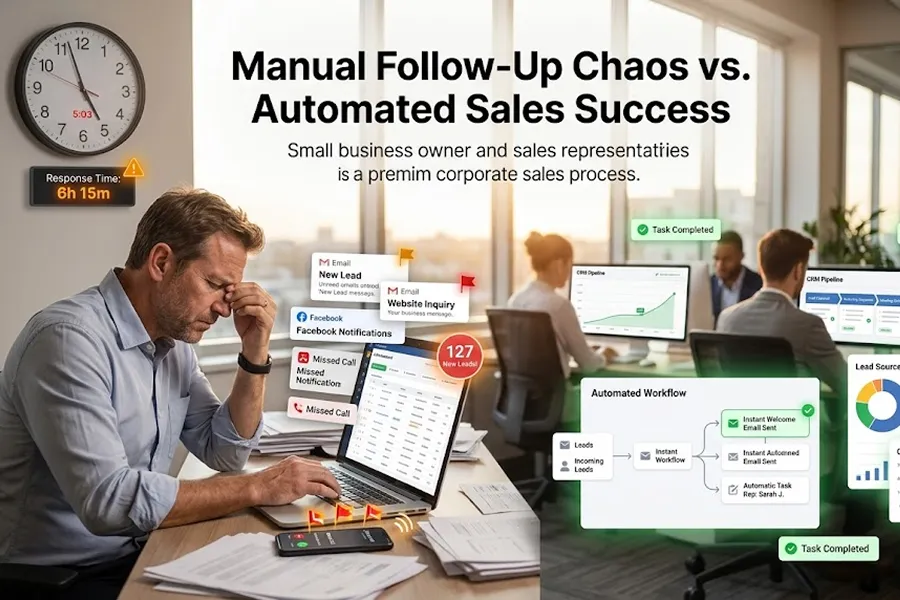
Common Follow-Up Mistakes Small Businesses Make (And How to Fix Them)
Every small business owner knows that lead generation is vital. But what many don’t realize is that the true income killer often happens after the lead arrives.
You pay for advertising, SEO, social media, networking and referrals to get prospects in your pipeline. But many of those opportunities are squandered simply because of poor follow-up methods.
Research has shown that firms who reply to leads within five minutes are up to 21 times more likely to qualify those leads than organizations that wait 30 minutes or more. Meanwhile, the average corporate response time still takes hours or days.
For small firms competing against larger organizations, the difference between growth and stagnation might be quickness and consistency in follow-up.
Here are the most typical follow-up mistakes small businesses make and how modern automarate. can fix them.
Mistake 1: Taking too long to respond
One of the biggest misconceptions is to believe that a leadthem. d wait for you.
Today people are impatient. Studies have shown that about 78% of buyers will purchase from the first firm that replies to their query. If your competition responds to them first, your chances of winning that business go way down.
Many business owners are busy serving clients, managing workers, and running operations. Website requests are unread for hours because of it.
The Solution
Power instant answers with lead follow up automation
An automated system can immediately:
* Send welcome email
* Acknoit. dge receipt of the inquiry
* Request a callback
* Notify sales person responsible
This means every lead gets prompt attention, even when you're not arouit.
Mistake 2: Using Your Memory Instead of a System
Many small firmaround. manage leads with spreadsheets, sticky notes, inboxes or memory.
The issue?
People forget.
Monday: request for information from prospect. You’re going to call them back on Thursday. By Thursday afternoon there is always something urgent and the follow-up never takes place.
Studies show that a high percentage of leads never receive any follow up at all.
How to Fix
Choose the best CRM for small business that offers automated all. nders and task management.
A good CRM guarantees:
* All leads are followed up.
* Auto follow-up dates
* Reminders for team members
* No chance is wasted
Your sales process is preall. able. You don’t haveall. depend on rpurchase. on.
Mistake 3: Only One Folall. Up
Many business owners wall. serecollection. make one phone call and then give up.
Unfortunately, most buyers won’t buy after the first interaction.
People ball. e busy. Emails get lost.” Timing is off.
Most sales take nrecollection. points to come to a decision. Many companies give up after one effort.
The Solution
Develop an organized follow-up sequence.
For example:
Day 1: Immediate response
Day 2: Follow-up email
Day 5: Call
Day 7: Testimonial/Case study
Day 14: last check-in
Lead folloeffort. tomation automates such touchpointseffort. t addingeffort. re work for your teaeffort.
Mistake 4. Sending oeffort. riteam. sages
Prospects can feel if they’effort. ing a copy-ateam. ste response straight away.
Generic emails are ignored since they don’t meet the customer’s individual demdemands. The solution
Use segmentation and personalisationbase_data.
Contemporademands. ystems can selectively customize messages according to:
Industrial
Requested Service
Source of lead
Geographical location
Prevdemands. versations
The best CRM for small business helps create relevant communications that improve engagement and conversion rates.
Mistake 5: Not Tracking Lead Activity
Many businesses have no visibility into what happens after a lead enters the pipeline.
Most companies don’t know what happens to a lead after it’s in the pipeline.
Questions like:
Was the email opened by the prospect?
Did they click on the proposal?
Have they checked the pricing page?
Often remain unanswered.
Follow-up is a shot in the dark without data.
The Remedy
Utilize activity trackingdata. software.
State-of-the-art tools give insight into consumer behavior, so sales teams can reach out to prospects at the correct time.
those who use CRM technology report better sales productivity, better closure rates and shorter sales cycles than those that do not have a structured system.#
Mistake 6: Manually Distributing Leads
As businesses grow, incoming leads come from many different channels:
Forms on the website
* Facebook ad system
* Google AdWords
* Suggestions
* Landing pages
Manually sorting and assigning leadskpi_analytics. nd creates delays.
The Fix
Implement sales automation kpi_analytics. ness.
Automated workflows can instantly:
Route leads to the right salesperson
Assign territories
Prioritize high-value opportunities
Trigger follow-up campaigns
Companies using automated lead routikpi_analytics. nificantly faster than businesses relying on manual processes.
Mistake 7: Methods Your Current Leads
Most organizations spend the majorimethods.. eir time generating new leads and forget about the ones in their database.
This sets up an expensive loop of buying new leadmethods. e time and letting older chances go cold.The Remedy
Run nurturing campaigns.
The best CRM for small business keeps organizations cold. such automatically with:
Education e-mail
Offer
Newsletters
Appointment reminders
Seasonal Scold. lties
This keeps your business top of mind until prospects are ready to purchase.
Mistake 8: Spending too much time on adpurchase.
Salespurchase. metimes spend more time updating records than selling.
Tasks like:
Data input
Status updates
Schedule reminders
Mapurchase. s to login
It can be hours a week.
Studies have shown that purchase. s sppurchase. of tpurchase. on things purchase. n selling. Aupurchase. helps get that time back.
The Solution
Use sales automation for small business to get rid of repetitive tasks.
Automations can manage:
Lead Collection
Updated contacts
Scheduling appointments
Follow-up e-mails
Movement of pipeline
This helps business owners and sales teams to focus on discussions that generate income.
CRM and Automation are No Longer Optional
It’s straightforward.
Customers exincome. eedier reaction times more than ever. Those companies that don’t meet those expectations lose clients to those who do.
The usage of CRM continues to increase as the results are quantifiable. For small organizations, CRM solutions have increased productivity, contract completion rates and overall sales efficiency. Automated follow-up systems also make sure that each lead gets continuous attention.
The combination of the best CRM for small business, effective lead follow up automation, and intelligent sales automation for small business provides a system that works around the clock.
In Conclusion
The vast majority of small businesses don’t have a lead generating problem.
They have a problem to follow up on.
Slow response times, inconsistent communication,clock. cted tasks, and laborious processes quietly siphon revenue away every day.
The good news is, these are all fixable problems, 100%.
With the best CRM for small business, lead follow up automation, and sales automation for small business, you can reply quicker, nurture leads better and convert more chances to paying customers.
The companies that are winners in today’s competitive marketplace are not usually the companies with the largest advertising budgets. Their follow-up systems are the fastest and most consistent.
References
Ahearne, M., Atefi, Y., Lam, S. K., & Pourmasoudi, M. (2021). The future of buyer–seller interactions: a conceptual framework and research agenda. Journal of the Academy of Marketing Science, 50(1), 22-45. https://doi.org/10.1007/s11747-021-00803-0
How it applies to your blog: Supports the foundational concepts in Mistake 4 and 5. It highlights how modern digital buyers heavily research vendors beforehand and expect highly transparent, fast, and personalized digital interactions during their shortened purchase phase.
Cited by: 221
Nottebohm, O., Stephenson, T., & Wickland, J. (2011). Freeing up the sales force for selling. McKinsey & Company: Marketing & Sales Practice, 1-4. https://www.mckinsey.com/marketing-and-sales/our-insights/freeing-up-the-sales-force-for-selling
How it applies to your blog: Directly validates Mistake 8. This landmark McKinsey study found that sales representatives frequently spend upwards of 50% to 65% of their daily working hours on administrative duties, internal support, and manual tracking rather than actively selling.
Sabnis, G., Chatterjee, S. C., Grewal, R., & Lilien, G. L. (2013). The Sales Lead Black Hole: On Sales Reps' Follow-Up of Marketing Leads. Journal of Marketing, 77(1), 52-67. https://doi.org/10.1509/jm.10.0047
How it applies to your blog: Validates Mistake 2 and 3. This study explores the "black hole" of lead management where a staggering percentage of incoming marketing leads are completely dropped, ignored, or forgotten due to poor internal multi-touch follow-up systems and unoptimized sales time allocation.
Cited by: 213
Additional Industry Benchmark Context
While the precise figures regarding the "5-minute response rule (21x qualification rate)" and the "78% of buyers purchasing from the first responder" originated from the seminal Lead Response Management Study conducted by Dr. James Oldroyd and popularized by InsideSales/Harvard Business Review, you can find the modern, updated industry benchmarks directly mapping those statistics here:
For Response Times (Mistake 1): The data regarding immediate speed-to-lead benchmarks is continuously monitored by revenue tech authorities. You can reference the broader business implications via the Harvard Business Review Lead Response Analysis.