Choosing Onshore vs Offshore Outsourcing: Effects on Communication, Cost, and Quality
Outsourcing Is a Strategy Decision, Not a Geography Decision
Outsourcing is no longer just a cost-saving tactic - it’s a core growth strategy.
Yet many businesses struggle to decide between:
Onshore outsourcing (domestic teams)
Offshore outsourcing (global teams)
The wrong choice leads to communication breakdowns, inconsistent quality, hidden costs, and leadership frustration. The right choice creates leverage, scalability, and predictable execution.
At MBA (My Business Automated), we help companies choose - and design - the right outsourcing model based on outcomes, not assumptions.
This article breaks down how onshore and offshore outsourcing impact communication, cost, and quality, and how to choose the right model for your business.
The Real Question Isn’t Onshore vs Offshore
Most leaders ask:
“Should we outsource onshore or offshore?”
The better question is:
“What level of control, speed, and scalability does our business require?”
Outsourcing success depends less on location - and more on structure, systems, and governance.
Communication: Speed, Clarity, and Context
Onshore Outsourcing Communication
Advantages
Same time zone
Cultural and language alignment
Faster real-time collaboration
Limitations
Higher cost per hour
Limited talent availability
Communication still fails without clear processes
Onshore teams communicate well - but only when roles and workflows are clearly defined.
Offshore Outsourcing Communication
Advantages
Follow-the-sun execution
Access to global talent
Structured communication rhythms
Challenges
Time zone differences
Cultural nuance
Requires stronger documentation
Offshore communication works when systems replace assumptions.
With SOPs, workflows, and clear escalation paths, offshore teams can outperform ad-hoc onshore setups.
Cost: More Than Hourly Rates
Onshore Cost Considerations
Higher wages
Payroll taxes and benefits
Compliance and HR overhead
Slower scaling due to hiring constraints
Onshore outsourcing often costs 2–4x more than offshore for comparable roles.
Offshore Cost Considerations
Lower labor costs
Flexible scaling
Reduced overhead
Ability to reinvest savings into growth
However, cost advantages disappear if:
Work is poorly scoped
Quality issues cause rework
Oversight is unclear
Cheap outsourcing is expensive. Structured outsourcing is efficient.
Quality: Output Depends on Systems, Not Location
Onshore Quality Perception
Onshore teams are often assumed to be “higher quality,” but quality still depends on:
Clear expectations
Performance measurement
Feedback loops
Without structure, even onshore teams underperform.
Offshore Quality Reality
Offshore teams deliver high quality when:
Roles are outcome-defined
Processes are documented
Performance is measured
Training is continuous
Many offshore professionals bring deep specialization and strong execution discipline - especially when embedded into client systems.
Onshore vs Offshore: Side-by-Side Comparison
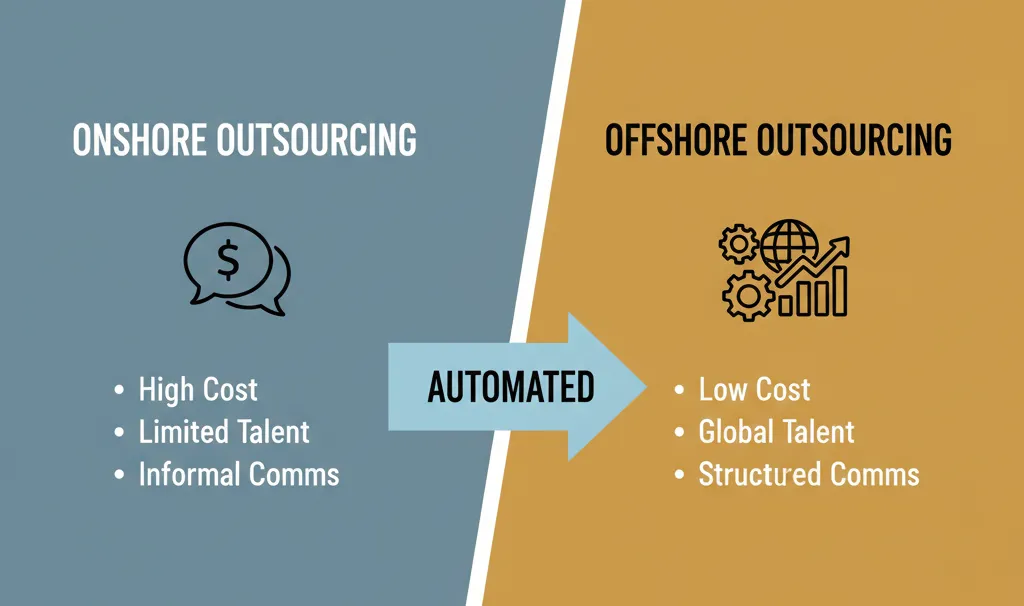
Onshore and offshore outsourcing differ significantly in how they impact communication, cost, talent access, and scalability. Onshore outsourcing typically enables real-time, informal communication due to shared time zones and cultural alignment, making it well suited for strategy, leadership, and stakeholder-facing roles. However, it comes with higher costs, a more limited talent pool, and slower scaling due to hiring constraints and labor market saturation. Quality control in onshore models often depends on individual processes and team discipline rather than formalized systems.
Offshore outsourcing, by contrast, relies on structured and asynchronous communication, which requires clearer documentation and defined workflows but enables continuous progress across time zones. It offers lower, more scalable costs and access to a global, highly specialized talent pool, allowing businesses to scale faster and more flexibly. In offshore models, quality control becomes process-critical - success depends on well-defined standards, performance metrics, and governance. As a result, offshore outsourcing is particularly effective for execution-heavy, operational, and repeatable functions when supported by strong systems and oversight.
The Hybrid Model: Best of Both Worlds
Many high-growth companies succeed with a hybrid model:
Onshore teams handle strategy, client-facing roles, and decision-making
Offshore teams handle execution, operations, and scale
This model delivers:
Strategic clarity
Cost efficiency
Execution velocity
Artifacts That Make Outsourcing Work (Anywhere)
Outsourcing succeeds when supported by operational artifacts.
Core Outsourcing Artifacts
Role-to-Outcome Maps
Standard Operating Procedures (SOPs)
Workflow & Handoff Diagrams
Communication Cadence Plans
Quality Assurance Checklists
Performance Dashboards
These artifacts eliminate ambiguity and reduce dependency on geography.
Common Outsourcing Mistakes to Avoid
Choosing based on cost alone
Outsourcing before documenting processes
Treating teams as vendors, not partners
Failing to define ownership
Expecting people to fix broken systems
Outsourcing amplifies what already exists - good or bad.
Why MBA: Outsourcing Designed as an Operating Model
MBA doesn’t “place talent.” We design outsourcing operating systems.
Our approach:
Outcome-first role design
Systems and automation integration
Governance and performance visibility
Scalable, repeatable frameworks
We help businesses use onshore, offshore, or hybrid models intentionally - not reactively.
Conclusion: Choose Structure First, Geography Second
Onshore vs offshore outsourcing is not about right or wrong - it’s about fit.
When outsourcing is:
Structured
Systemized
Governed
Both models can deliver exceptional results.
The businesses that win are those that design for scale first - and staff second.
References
Harvard Business Review – Managing Outsourcing
https://hbr.org/McKinsey – Global Operating Models
https://www.mckinsey.com/capabilities/people-and-organizational-performance/our-insightsDeloitte – Global Business Services
https://www.deloitte.com/global/en/our-thinking/insights/topics/global-business-services.htmlGartner – Strategic Outsourcing
https://www.gartner.com/en/information-technology/insights/outsourcingWorld Economic Forum – Global Talent Trends
https://www.weforum.org/Forbes – Onshore vs Offshore Outsourcing
https://www.forbes.com/PwC – Workforce Transformation
https://www.pwc.com/gx/en/services/workforce.htmlBain & Company – Scaling Operations
https://www.bain.com/insights/topics/operational-excellence/MIT Sloan – Managing Global Teams
https://sloanreview.mit.edu/SHRM – Global Workforce Best Practices
https://www.shrm.org/