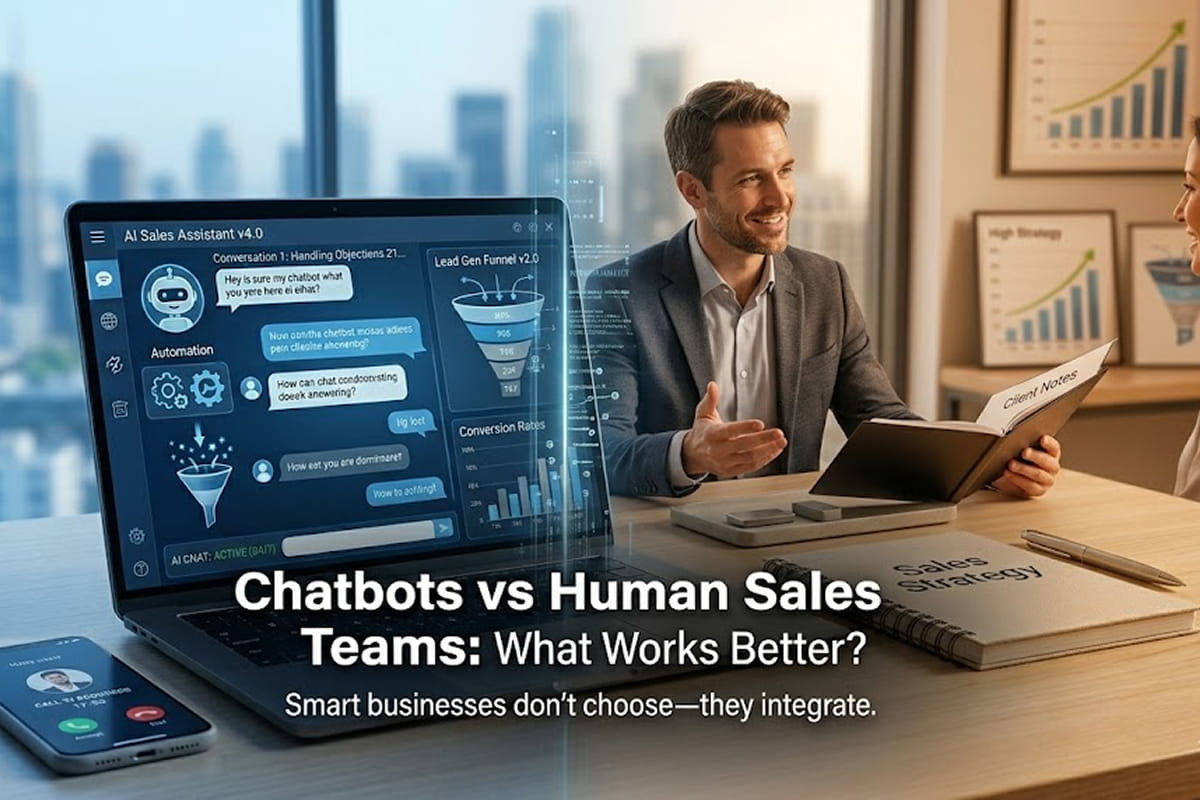
Chatbots vs Human Sales Teams: What Works Better?
Businesses are always pressured to respond faster, communicate better, and transform leads into consumers faster in today's fast-paced digital world. Business owners sometimes ask if they should employ chatbots or real people to sell items. You can't just pick one; you need to know what each does best and how to use them wisely.
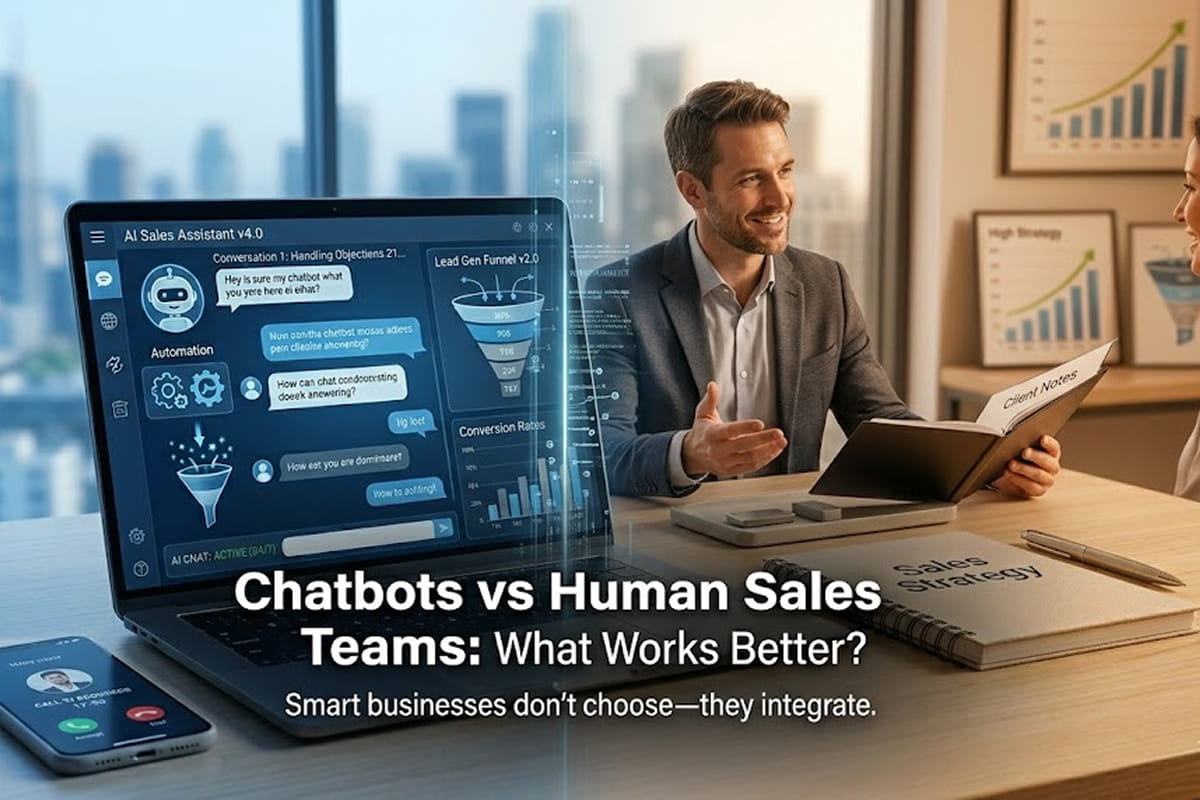
Chatbots are powerful because they are quick, can grow, and are dependable.
Companies now handle first-contact communications differently because of chatbots. They work all day and night, answer right away, and can handle hundreds of conversations at once without becoming weary. This is a significant problem for small businesses and MSMEs.
A well-designed chatbot can qualify leads, answer frequently asked questions, schedule appointments, and even follow up with potential customers on its own. This stops delays and ensures that we take every opportunity. In areas like real estate, healthcare, or digital services, where reaction time has a direct impact on conversion rates, chatbots can make a big difference.
Chatbots also save a lot of money. Instead of hiring a lot of new salespeople, companies can automate dull jobs and let their current ones do more vital work.
But chatbots can't do everything. Because they follow rules, they may have problems with sophisticated objections, emotional nuances, or conversations where a lot is on the line.
The Strength of Human Sales Teams: Trust, Emotion, and the Ability to Close
Salespeople are superior to bots because they can read people's emotions and adapt their behavior in real time. When a prospect is considering a major investment or has special issues, talking to a real person makes them feel more at ease and trustworthy.
Experienced salespeople can read tone, handle objections, and adjust their pitch based on subtle signs. This is very crucial in business-to-business (B2B) contexts, for high-ticket sales, and in fields where connections are important.
People are also quite skilled at making deals. Chatbots can help a potential customer go down the funnel, but the final conversion often hinges on things that people do best, including reassurance, bargaining, and building trust.
The worst part? Groups of individuals are costly, don't have much time, and are likely to not be reliable. Sales can suffer from missed calls, late responses, and uneven work.
A Sales System That Works in Both Ways
"Chatbots and humans working together" is better than "chatbots vs. humans."
This is how a system that functions well looks:
Chatbots handle the front end by answering questions rapidly, getting leads, certifying them, and setting up appointments.
Automation helps leads grow by delivering them follow-up messages, reminders, and sequences that get them to interact.
Sales teams of people jump in at the proper times to talk to qualified leads, set up meetings, and complete sales.
This blended strategy ensures that we get things done fast without losing the personal touch. Also, it maximizes your investment because your staff only works on leads that are ready to buy.
The Bottom Line
If you rely solely on individuals, you can miss out on opportunities and be less productive. You can lose the personal touch that fosters trust and sales if you only utilize chatbots.
This is what successful firms know: machines take care of quantity and people take care of quality.
It's not about which is better; it's about how well you integrate the two to create a smooth, profitable sales engine.
If your current system isn't doing that, it's not a problem with people or technology. It's a problem with the plan.
References
Hemmer, P., Schemmer, M., Kühl, N., Vössing, M., & Satzger, G. (2024). Complementarity in human-AI collaboration: Concept, sources, and evidence. arXiv. https://doi.org/10.48550/arxiv.2404.00029 Cited by: 119
Prasad, R. (2026). The impact of AI on marketing automation and customer satisfaction. E-Research Siam. https://e-research.siam.edu/wp-content/uploads/2026/02/MBA-IS-2025-Rohit-Prasad-6617193002-The-Impact-of-AI.pdf
Wah, J. N. K. (2025). Revolutionizing e-health: The transformative role of AI-powered hybrid chatbots in healthcare solutions. Frontiers in Public Health, 13. https://doi.org/10.3389/fpubh.2025.1530799 Cited by: 58
When AI meets consumer behavior: Exploring how human-like AI chatbots shape trust in consumer purchase intentions. (2025). The Regional Tribune, 4(1), 5. https://www.researchgate.net/publication/393631046_When_AI_Meets_Consumer_Behavior_Exploring_How_Human-Like_AI_Chatbots_Shape_Trust_in_Consumer_Purchase_Intentions
Artificial intelligence in business-to-business sales processes. (2019). Diva-Portal. https://www.diva-portal.org/smash/get/diva2:1328720/FULLTEXT03.pdf