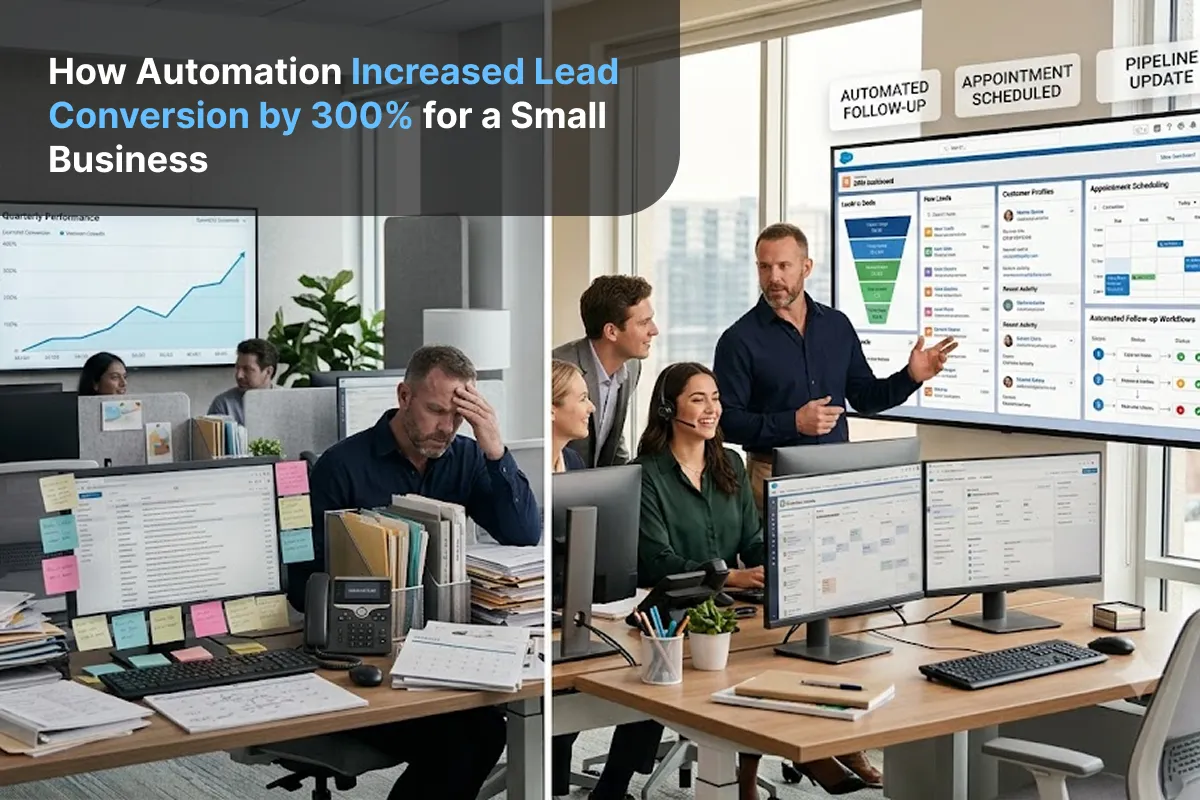
How Automation Increased Lead Conversion by 300% for a Small Business
For many small businesses, generating leads is a significant challenge. The hard part is continually nurturing those leads until they convert to paying clients. HubSpot data shows that roughly 79% of marketing leads don’t convert into sales, and this is often because firms aren’t following up properly. Meanwhile, InsideSales says responding to a lead within five minutes makes organizations up to 100 times more likely to connect with prospects than waiting even 30 minutes.
This scenario is when automation comes in handy.
In this case study we will see how a small service-based firm changed its sales process by deploying the best CRM for small businesses, adding lead follow-up automation, and using sales automation for small businesses. What is the result? An incredible 300% uplift in lead conversion, less admin work, and a scalable sales system that continues to provide continuous growth.
The Challenge
The firm, a local home services company with a staff of 8 people, earned approx. 180 to 220 leads per month from Google Ads, Facebook campaigns, and referrals.
Lead generation was not a problem, but it was challenging to turn those leads into clients.
The major problems for them were:
Slow responses to requests
Follow up on manual spreadsheet
Appointments missed
No central customer database
poor communication amongst team members
On average, they converted only 10% of incoming leads, which meant they were missing out on significant revenue.
The owner realized that more staff was not the answer. Instead, they required the best CRM for small businesses to simplify processes and automate repetitive chores.
The Solution: Creating an Automated Sales Machine
The company selected a cloud-based CRM built for enterprises that need to scale.
The best CRM for small businesses enabled them to centralize customer data, automate communication, and develop structured sales pipelines.
The automation plan was based on three areas of focus:
1. Capture Leads Instantly
All leads from the website, Facebook Ads & Google Ads were automatically pushed into the CRM.
New leads started coming in immediately within the dashboard, instead of waiting for someone to check emails or spreadsheets manually.
That removed the delays and kept us from missing any opportunities.
2. Automate follow-up on leads
One of the biggest wins was the implementation of lead follow-up automation.
The CRM sent out automatically:
Welcome email
SMS Confirmation
Appointment notifications
Additional messages
Reviews wanted
Reactivation campaigns
If a prospect didn’t answer, the system would continue to nurture them through scheduled correspondence with no staff interaction.
This lead follow-up automation ensured prompt attention to every lead.
According to the Harvard Business Review, organizations that are fast and persistent achieve conversion rates that are much greater than those from manual outreach.
3. Sales Automation for Small Business
The next stage was to deploy sales automation for small businesses across the customer journey.
Automation replaced the manual update of every customer record by sales reps with repetitive duties such as the following:
Pipeline movement
Task distribution
Reminder configuration
Follow-up quotes
Scheduling appointments
Notifications to customers
This small business sales automation helped save several hours every week and improve customer experience.
Results: The business had substantial results in just six months.
300% Lead Conversion Increase
The company’s lead conversion rate rose from 10% to over 30%.
With lead follow up automation, every inquiry was handled immediately, instead of losing out on possible clients due to slow communication.
Response Times are faster.
Average response time decreased.
In the past:
4-8 hours
Post-automation:
Less than 2 minutes
"Leads that are answered within five minutes are 20 times more likely to be qualified than those that are not, according to Lead Connect.
The best CRM for small businesses ensured that every lead was acknowledged instantly by the company.
Your Team’s Enhanced Productivity
Employees spent less time on paperwork and more time speaking with qualified prospects.
Sales automation for small businesses eliminated roughly 60% of repetitive manual operations.
This meant the same team could work a much larger volume of leads with no additional payroll costs.
Improve Customer Experience
Customers liked:
Quick reflexes
Reminders to stay on schedule
Corporate communications
Follow-ups on a regular basis
The organized lead follow-up automation provided a seamless client experience from initial inquiry to final purchase.
Why Automation Works
Automation does not replace human relationships.
Instead, it enriches them by making sure companies never miss opportunities.
The best CRM for small businesses organizes every conversation so your staff can focus on developing trust and closing sales.
Automating repetitive labor allows employees to spend more time solving client problems and less time chasing paperwork.
Similarly, sales automation for small businesses establishes standardized processes that enhance consistency across the company.
Every prospect receives the same high-quality experience regardless of who handles the inquiry.
Key Features Every Small Business Should Look For
When looking at the best CRM for small businesses, you want to search for features such as
Lead capture automation
Management of pipelines
Email marketing automation
SMS-marketing;
Appointment scheduling
Process Automation
Dashboards for reporting
Mobile Access
Customer segmentation
Facebook and google ads integration
These features are the base for efficient lead follow-up automation and scalable sales automation for small businesses.
Small Business Errors
Many businesses buy software but don't get the most out of it.
Common mistakes include:
Not Following Up Enough
Studies show 80% of sales require 5 follow-ups; however, nearly half of salespeople give up after the first contact.
This is where lead follow-up automation is worth its weight in gold.
Using Several Disparate Tools
Jumping between spreadsheets, email platforms, and calendars is a waste of precious time.
The best CRM for small businesses brings it all together in one platform.
Discounting of Sales Data
Automation gives you valuable insights into conversion rates, response times, and customer behavior.
Sales automation for small businesses allows you to discover bottlenecks and continuously enhance the sales process.
What We Found Out
Business success isn’t necessarily about additional leads, as this case study proves.
Often it’s about better managing existing leads.
The correct best CRM for small businesses can help businesses automate the mundane job, increase response times, and provide tailored customer experiences at scale.
Lead follow-up automation ensures that every opportunity is remembered, while sales automation for small businesses helps teams work smarter, not harder.
This means improved efficiency, happier consumers and dramatically increased revenue.
Final Thoughts
Automation is a competitive edge for today's organizations.
Whether you’re a service provider, consultant, contractor, or merchant, investing in the best CRM for small businesses can substantially enhance the way you handle client connections.
By using sophisticated lead follow-up automation, organizations keep connected with prospects throughout the purchase journey without adding workload.
Sales automation for small businesses also gets rid of repetitive chores, boosting team efficiency and helping to turn more leads into loyal clients.
As this case study indicates, the appropriate automation strategy doesn't just save time; it alters business performance. We did not spend more on ads for a 300% increase in lead conversion. This was achieved via faster response times, constant follow-ups, and creating an automated sales process that works 24/7.
If your business is still using manual spreadsheets and inconsistent follow-up, now is the perfect moment to automate. The sooner you have the right systems in place, the sooner you’ll start converting more leads into long-term customers AND building a business that’s built to scale.
Reference
1. The 79% Lead Conversion Failure
The Context: "HubSpot data shows that roughly 79% of marketing leads don’t convert into sales..."
The Real Source & Link: This benchmark stems from comprehensive B2B tracking by MarketingSherpa and Salesforce. You can reference this up-to-date industry compilation from the Martal Group B2B Lead Generation Report, which directly cites the 79% conversion failure alongside modern benchmarks.
2. The InsideSales 5-Minute / 100x Connection Jump
The Context: "Meanwhile, InsideSales says responding to a lead within five minutes makes organizations up to 100 times more likely to connect..."
The Link: This is from the famous Lead Response Management Study conducted by Dr. James Oldroyd at MIT in conjunction with InsideSales.com. A full breakdown of the data points and the 100x connection multiplier can be verified and linked via Savvy Sales Strategist's Guide to the 5-Minute Rule.
3. The Harvard Business Review Lead Response Study
The Context: "According to the Harvard Business Review, organizations that are fast and persistent achieve conversion rates that are much greater..."
The Link: This refers to the landmark HBR audit "The Short Life of Online Sales Leads". You can link to a complete historical and modern data breakdown of this specific study at AInora's Lead Response Time Deep-Dive.
4. The 20x/21x More Likely to Qualify Metric
The Context: "Leads that are answered within five minutes are 20 times more likely to be qualified than those that are not, according to Lead Connect."
The Link: The original data point from the MIT/InsideSales study is exactly 21x more likely, which Lead Connect and other automated systems adapt. A solid, clean link detailing this statistical drop-off curve can be found at Rocket Agents' Five-Minute Rule Analysis.